
A Study on Triangular Fuzzy Clustering Model Under Uncertainty
Abstract
This paper will study a triangular fuzzy clustering model. Clustering or cluster analysis incorporates assigning data centers to clusters to make things in a similar gathering equivalent to normal in light of the current situation. In contrast, things with a spot with different clusters are as various as sensibly normal. In this study, since the problems faced by transgender people are fuzzy in nature, we have used fuzzy models to analyze their problems and cluster them in order of their weightage. This paper has four sections. Section one gives an introduction to the problem. The basics of the Triangular Fuzzy Clustering model are in section two. Section three deals with the application of the model in determining the cluster of problems under the three categories viz, 'low,' 'moderate,' and 'high.' The final section gives the conclusion and suggestions based on the result.
Keywords:ClusteringFuzzy setTriangular fuzzy numbersTransgenders and unbiased data’s
1. Introduction
With the advancement of science and technology, decision-making in business and industry has become highly complex and extremely difficult. Hence, decision-making can be defined as the process of generating and evaluating alternatives and making choices among them. Fuzzy Ranking is the collection of techniques that formulate ranking problems with flexible, approximate, or uncertain constraints and goals using fuzzy sets.
Fuzzy Models such as Fuzzy Cluster analysis, Triangular Fuzzy Numbers, and arithmetic operations of Triangular Fuzzy Numbers are used to analyze the problems of Transgenders and to obtain the dominant causes for the Transgenders so that policy measures and programmers are devised and implemented to ameliorate their issues. Here, the linguistic variables are expressed in terms of triangular fuzzy numbers. The concepts of fuzzy numbers, arithmetic operations, and related results have been effectively used to required variables.
1.1 Motivation
Mathematics has an effective role in everyday life in every period of human civilization. Advancements in science and technology still depend on Mathematics. No branch of knowledge is untouched by mathematics-economics, defense, space science, recent nanotechnology, or whatever field you name it. Mathematical logic has been used to analyze and solve problems in science and technology and fields like politics, sociology, economics, and psychology.
1.2 Literature Review
Fuzzy Cognitive Map (FCM) works on unsupervised data. It is a simple and effective tool to analyze social, economic, and political problems. The idea of a fuzzy set was introduced by Zadeh [1] in 1965. Vasantha Kandasamy and Smarandache [2] constructed the Fuzzy Relational Models and Fuzzy Cognitive Maps have effectively used the Fuzzy Models in analyzing the problems of displaced persons, school drop-outs, AIDs patients, Dalits, Rag pickers, PWDs, etc. It is a convenient, simple, and powerful tool used in numerous social, economic, and medical fields.
Sivakumar [3] analyzed cluster analysis multi-objective fuzzy linear fractional programming problem with trapezoidal fuzzy numbers. Larsen [4] proposed fuzzy set using Efficient computation of transitive closure. Bezdek [5] presented and studied fuzzy cluster using fuzzy relations and partitions. Das et al. [6] solved Neutrosophic LFPP with mixed constraints and obtained the optimal solution. Solving via Metaheuristic Algorithms [7], such as genetic algorithms, particle swarm optimization, and simulated annealing, have been adapted to solve FLFP problems by treating fuzzy numbers as interval-valued or crisp values during optimization. Saraswathi [8] developed fuzzy-trapezoidal DEMATEL approach method for solving decision making problems under uncertainty. Prakash [9] modified a combined fuzzy clustering model for the engineering students. Bharathi and Saraswathi [10] used a Pivotal Operation on Triangular Fuzzy Number for Solving Fuzzy Nonlinear Programming Problems. Bezdek et al. [11] made algorithm and compared FCM wirh the fuzzy c-means clustering algorithm. Adiga [12] enhanced a ranking analysis/An interlinking approach using triangular fuzzy cognitive maps and combined effective time dependent matrix, The remaining section of this paper is organized as follows. Section 2 introduces the concept of fuzzy logic, fuzzy set, Triangular fuzzy numbers, Fuzzy clustering, Classical Fuzzy Clustering, Shaped-based Fuzzy Clustering, K-means Clustering and Fuzzy C-means Clustering, arithmetic operations and related results. Section 3 presents the application of the model in determining the cluster of problems. Section 4 points out some conclusions based on our discussion at the end of this paper.
2. Preliminaries
2.1 Fuzzy Set
Let X be a universe of discourse, and x is any element in X, then a fuzzy set is denoted by Ã= {x,μÃ(x)):x∈X}.
2.2 Fuzzy Number
A fuzzy set defined on the set R of real numbers whose membership function is of the form Ã: R→ [0,1] is a fuzzy number under certain condition.
I. Ã is normal height (Ã)=1.
II. Ã is convex.
III. Ã is piecewise continuous.
2.3 Triangular Fuzzy Number
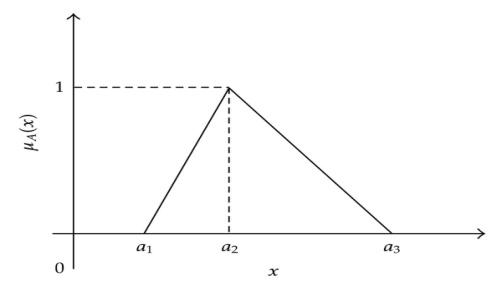
A triangular fuzzy number à = (a1, a2, a3) is defined by its membership functions 0, for x < a1, x − a1 , for a1 ≤ x ≤ a2, a2 − a1 μA(x) = a3 − x , for a2 ≤ x ≤ a3, a3 − a2 {0, for x > a3, where a2 denotes the modal value of the fuzzy number and a1,a3 are left and right deviation from the modal or middle value.
The membership function is defined as
2.4 Arithmetic Operation of Triangular Fuzzy Number
For arbitrary triangular fuzzy numbers A ̃ = (a , a , a ) and B ̃ = (b , b , b ) and ∗ = {+, −,×,÷}, the arithmetic
1 2 3 1 2 3
operations on the triangular fuzzy numbers are defined by A ˜ ∗ B ˜ = {a ∗ b /a ∈ A ˜ , b ∈ B ˜ }.
i j i j
In particular, for any two triangular fuzzy numbers A ˜ = (a , a , a ) and B ˜ = (b , b , b ), we define
1 2 3 1 2 3
I. Addition (+): A + B = (a1 + b1, a2 + b2, a3 + b3).
II. Subtraction (-): A − B = (a1 − b1, a2 − b2, a3 − b3).
III. Multiplication (⊗):
k ⊗ A = (ka1, ka2, ka3), k ∈ R, k ≥ 0, A ⊗ b = (a1b, a2b, a3b), a1 ≥ 0, a2 ≥ 0, a3 ≥ 0.
IV. Division (∅)
−1 −1 1 1 1
(A) = (a1, b1, c1) ≅ ( , , ) , a1 > 0, b1 > 0, c1 > 0,
c1 b1 a1 a1 b1 c1
A∅B ≅ ( , , ) , a1 ≥ 0, a2 > 0.
c2 b2 a2
2.5 Fuzzy Clustering
Fuzzy Clustering (additionally suggested as soft clustering or soft k-means) is a gathering of groups where every datum point can have a spot with more than one clustering. Methods for similarity measures recognize clusters. These likeness estimates consolidate division, accessibility, and force. Distinctive similarity measures might be gathered subject to the information, or the application of Fuzzy Clustering has a drawback.
Fuzzy clustering methods are divided into two regions:
I. Classical fuzzy clustering.
II. Shape-based fuzzy clustering.
2.6 Classical Fuzzy Clustering
I. Fuzzy C-means method: a data point can have a spot with all social occasions, with an enrolment work someplace in the scope of 0 and 1, where 0 is the in a specific way from the gathering's inside, and 1 is the near data point to the center.
II. Gustafson-Kessel (GK) is a data point with clusters and a matrix. The c-mean conjectures that the clusters are circular while GK has bent-shaped groups.
III. Gath-Geva algorithm: This algorithm is portrayed as a Gaussian mixture decomposition.
2.7 Shaped-Based Fuzzy Clustering
Circular Shaped: an algorithm that constrains data points into circular shapes.
Elliptical Shaped: an algorithm that constrains data points into elliptical shapes.
Generic Shaped: it may be neither circular nor elliptical. The generic algorithm allows data points into clusters.
2.8 K-Means
The k-means algorithm given by Macqueen is one of the simplest algorithms that solve clustering problems. K-means clustering is a system of vector quantization. K-means clustering points to n observations into k clusters in which every observation belongs to the cluster with the nearby mean platter as a prototype of the cluster.
Algorithm
I. K-means unremitting shapes cluster centroids for every single division measure over the arrangement to stop the whole concerning the fixed gauge.
II. The k-means algorithm was chosen to affect the unprejudiced exertion known as the squared blunder measure given in the condition.
JKM(X:V) = ∑ ∑ Dij2,
i=1 j=1
where D 2 is the chosen distance measure generally in Euclidean norm ∥x − v ∥, 1 ≤ i ≤ c, 1 ≤ j ≤ n where
ij ∥ ij i∥ i
ni represents the number of data points in ith cluster.
2.9 Fuzzy C-means
Fuzzy clustering is, in any case, called soft clustering. In FCM, information focuses can be used in situations with multiple groups. This way, it utilizes the least square reaction to locate the best condition for any information point.
Algorithm
The FCM method is one of the most widely used fuzzy clustering algorithms. This technique was first initiated by Prof. Jim Bezdek [11].
I. This method is based on the minimization of the following objective function.
Jij = ∑ ∑ uij |xi − cj| 2,
i=1 j=1 where I. m- Real number >1.
II. C- Number of Clusters.
III. N- Number of data.
IV. uij- Level of belonging of in the cluster j.
V. xi- ith d-dimensional estimated data.
VI. cj- d-dimensional interior of the cluster.
VII. ‖∗‖ is any norm demonstrating the nature joining any measured data and the cluster.
3. Application of the Model in Determining the Cluster of Problems
Fuzzy C-Means Clustering In fuzzy clustering, each point has a degree of belonging to clusters, as in fuzzy logic, rather than belonging entirely to just one cluster. Thus, points on the edge of a cluster may be in a cluster to a lesser degree than points in the cluster's center; for each point x, there is no coefficient giving the degree of belonging in the kth cluster μk(x) = 1. Usually, the sum of those coefficients is defined to be 1.
3.1 About Transgenders
Every child by birth will be male or female. As they grow up, hormonal changes take place and make them Transgender. Transgender people are called Hijras in India and are often discriminated against in jobs, forcing them to resort to begging and indulging in sex work. Parents should realize and accept their feelings. However, the parents who accept physically challenged kids are not ready to accept these kids wholeheartedly. Parents feel ashamed of those persons and push them out of their families. As they are pushed out of their families, they encounter many societal problems. They are ignorant of the causes of their status.
Their family members, as well as the community around them, are also ignorant of the real cause of their status as Transgenders. The parents and family members feel ashamed of having given birth to such a child. They feel it is a curse of God. As a result, they are pushed out of the family at one point. They remain as illiterate, ignorant, homeless, jobless, and, as a result, pushed to beg or be involved in sex work to earn their living. The police officers, who are supposed to safeguard such vulnerable sections of society themselves, misuse these people to satisfy their animal pleasure. Due to a lack of knowledge on protected sex, they fall prey to deadly diseases such as HIV/AIDS, etc. Even the government has not given any proof of identity. That is required to get admission to school, get employed, get an adult franchise, get government rehabilitation measures, etc. As a result, they live a degraded life of depression and trauma, depending on begging and flesh trade to make their living. 100 Transgender were interviewed for our study. Each was individually given enough time to express their views on their Problems. Their opinions are considered attributes, and the Triangular Fuzzy Clustering model is used to analyze the significant causes among the listed.
The following problems are listed based on our interview and survey among the Transgender, Parents of Transgenders, and NGO-Leader Views:
C1- Penury (poverty).
C2- Hormone's disorder.
C3- Sexually biased.
C4- Public cheating.
C5- Affected by HIV/AIDS/other health disorders.
C6- Isolated from public.
C7- Unawareness.
C8- Drug addiction.
C9- Bad companionship.
C10- Deprived from facilities.
The ratings and the Standard Deviation of the attributes for the causes of Transgenders have been subjected to a triangular extended fuzzy clustering algorithm, and the following results are shown in Table 1 according to the expert's opinion.
Table 1. Degrees of triangular fuzzy numbers.
This table is shown in the PDF version of the article.
The following table gives the 3-cluster combination. The first cluster consists of the attributes with an average rating from 2.5 to 5.5 with a mid-value of 4. The second cluster range is from 3.5 to 7.5 with a mid-value of 5.5, and the third cluster has a range of 4.5- 10 with a mid-value of 9.75.
Table 2. Cluster range of level of dominant cause.
This table is shown in the PDF version of the article.
Cluster 1, Cluster 2, and Cluster 3 show the Low, moderate, and high levels of weightage for the causes of the Transgenders. For Cluster 1, Cluster 2, and Cluster 3 ranges 2.5-5.5, 3.5-7.5, 4.5-10 Mid value 4,5.5,9.75 Tr Fuzzy Avg 0.25 0.50, 0.75 and its classification LOW, MEDIUM and HIGH are as shown in the above Table.
3.2 Algorithm to Find a Triangular Membership Value for the Attributes
Step 1. Assign values to the attributes on a 10-point rating scale in a set D.
Step 2. Classify Cluster 1 as Low with an initial value of 2.5 (Iv1) and a final value of 5.5 (Fv1), Cluster 2 as MODERATE ranges with 3.5 (Iv2) and 7.5 (Fv2), and Cluster 3 as HIGH, whose range beginning with 4.5 (Iv3) end with 10 (Fv3).
Step 3. Select an element x in D.
Step 4. If x<(Fv1) and x>(Iv2), then x lies in cluster 2 and cluster 3, whose membership value is given as the average of the linguistic values of the corresponding clusters (i.e.) cluster1 and cluster 2 and then the highest membership value among them is threshold and updated as one and the lowest membership value as 0. Suppose the x < (Fv1) condition is unsatisfied; then x lies in cluster 1 only with the membership value 1. Step 5. If x < (Fv2) and (x>Iv3), then x lies in cluster 2 and cluster 3, whose membership value is given from the average of the linguistic values given of the corresponding clusters (i.e. cluster 2 and cluster 3 and then the highest membership value among them) is threshold and updated as 1 and the lowest membership value as 0. If the above condition is not satisfied, then x lies in cluster 2 only with the membership value 1.
Step 6. If x<(Fv2) condition is not satisfied, then x lies in cluster 3 only, the membership value 1.
Step 7. Repeat the same procedure for all the elements in the set D.
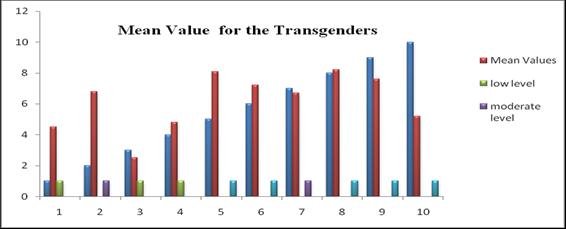
The following figure is the mean rating of the dominant cause obtained from Transgenders.
The following Table shows the degree of membership of the attributes of Transgenders.
Table 3. Degree of membership of the attributes of Transgenders.
This table is shown in the PDF version of the article.
4. Conclusion
Table 1 shows the threshold and updated values for the attributes belonging to the LOW, MODERATE, and HIGH levels. 1 denotes the on state, and 0 denotes the off state for the occurrence.
The analysis shows that attributes 1,3, and 4, with a mean rating of 4.5,2.5, and 4.8, come to the 'on a state' in cluster 1. (i.e. low level).
Attributes 2 and 7, with a mean rating of 6.8 and 6.7, come to the 'on state' in cluster 2. (i.e. moderate level). Attributes 5, 6, 8, 9, and 10, with a mean rating of 8.1,7.2,6,7,8.2,7.6 and 5.2, comes to the 'on state' in cluster 3. (i.e. high level).
We concluded that Cluster 3 attributes 5, 6, 8, 9 and 10.
(i.e. C5- Affected by HIV/AIDS/other health disorders, C6- Isolated from public, C8- Drug addiction C9- Bad companionship, C10- Deprived from facilities) are the dominant reasons for the Problems of Transgenders in Chennai.
4.1 Suggestions Based on Triangular Fuzzy Cluster
As the Transgenders are abandoned by their parents and they come in contact with other Trans-people. They stay away from their families and are forced to cut all relations with relatives. They are often abused by society and made to starve for want of food, shelter, education, health, and allied services.
In such circumstances, what is essential is awareness education among the parents and the masses, which indicates their right to special care. They must be treated at least as a Person With Disabilities (PWDs), if not as other normal children. They should be put under the special care of community-based organizations, provided with some community-based organizations to take of their rights, and given special quotas in jobs, education, and health services. Separate job allotments like in defense services or police service can be an effective solution for them to overcome their problem. Effective policies should be framed for them to face their problem effectively. Wherever possible, corrective surgery can be made free of cost to rectify the hormonal imbalances.
Since the Transgenders stay away from their homes, they have no one by their side, and these make them even more guilty and lonely and might even lead to mental problems. Their own don't support them or encourage them to develop along with other normal children. Being transgender is not a choice, but it happens as a result of hormonal problems. Being born as a Person With a Third sex (PWTs) is not due to their fault. So, it's really stupid on the part of humans to discriminate against them. Transgender should be treated equally on par with the other sexes because all are humans. Since these Transgender people are sent away from home, they have nobody who can fund them for their education. This results in poverty as nobody can accommodate them and find job opportunities. They are also not given a share in the property. As a result, they are pushed to live a marginalized life. Equal rights should be given to these people just like how other men and women are treated.
They should be given the right to education, and severe punishment should be imposed on people who are ill-treated or discriminated against; instead of excluding them as inferior people, they should be treated as one among us. They should also be encouraged to participate in other fields like sports, research, entertainment, etc. They should not be sent out of the home but brought up with the same love and affection that a normal child receives. Transgender should be treated as another sex, and they should be treated as a third sex. Transgenders should have the right to marry if they require a partner; they have a property right, right to health, education.
Authors' Contributions
All aspects of the research and manuscript preparation were carried out by the author. The author has read and approved the final version of the manuscript.
Consent for Publication
The author has given consent for the publication of this manuscript.
Ethics Approval and Consent to Participate
This study does not involve any research conducted on human participants or animals
Funding
This research received no specific grant from funding agencies in the public, commercial, or not-for-profit sectors.
Data Availability
No new data were created or analyzed in this study. Data sharing does not apply to this article.
Conflicts of Interest
The author has no conflicts of interest to declare relevant to this article's content. No new data were created or analyzed in this study. Data sharing does not apply to this article.
References
- [1] Zadeh, L. A. (1965). Fuzzy sets and fuzzy cognitive maps. Information and control, 8(3), 338–353. https://doi.org/10.1016/S0019-9958(65)90241-X
- [2] Kandasamy, D. W. B. V., & Smarandache, F. (2003). Fuzzy cognitive maps and neutrosophic cognitive maps. Infinite Study. https://fs.unm.edu/NCMs.pdf
- [3] Sivakumar, K., & Appasamy, S. (2024). Fuzzy mathematical approach for solving multi-objective fuzzy linear fractional programming problem with trapezoidal fuzzy numbers. Mathematical modelling of engineering problems, 11(1), pp. 255-262. https://doi.org/10.18280/mmep.110128
- [4] Larsen, H. L., & Yager, R. R. (1990). Efficient computation of transitive closures. Fuzzy sets and systems, 38(1), 81-90. https://doi.org/10.1016/0165-0114(90)90101-B
- [5] Bezdek, J. C., & Harris, J. D. (1978). Fuzzy partitions and relations; an axiomatic basis for clustering. Fuzzy sets and systems, 1(2), 111-127. https://doi.org/10.1016/0165-0114(78)90012-X
- [6] Das, S. K., & Edalatpanah, S. A. (2022). Optimal solution of Neutrosophic linear fractional programming problems with mixed constraints. Soft computing, 26(17), 8699–8707. https://doi.org/10.1007/s00500-022-07171
- [7] Das, S. K., Mandal, T., & Edalatpanah, S. A. (2017). A new approach for solving fully fuzzy linear fractional programming problems using the multi-objective linear programming. RAIRO-operations research, 51(1), 285-297. https://doi.org/10.1051/ro/2016022
- [8] Saraswathi, A. (2019). A fuzzy-trapezoidal DEMATEL approach method for solving decision making problems under uncertainty. AIP conference proceedings (Vol. 2112, No. 1, p. 020076). AIP Publishing LLC. https://doi.org/10.1063/1.5112261
- [9] Prakash, A. P., Jerlin, J. E., & Fernandes, J. B. (2014). A study on the causes for failures in Mathematics by engineering students using CFRM model. Proceedings of the world congress on engineering (Vol. 1). https://www.iaeng.org/publication/WCE2014/WCE2014_pp29-33.pdf
- [10] Bharathi, D., & Saraswathi, A. (2024). A pivotal operation on triangular fuzzy number for solving fuzzy nonlinear programming problems. Mathematics and statistics, 12(2), 126-134. https://doi.org/10.13189/ms.2024.120202
- [11] Bezdek, J. C., Ehrlich, R., & Full, W. (1984). FCM: The fuzzy c-means clustering algorithm. Computers & geosciences, 10(2-3), 191-203. https://doi.org/10.1016/0098-3004(84)90020-7
- [12] Adiga, S., Saraswathi, A., & Prakash, A. P. (2018). A ranking analysis/an interlinking approach of new triangular fuzzy cognitive maps and combined effective time dependent matrix. Journal of physics: conference series (Vol. 1000, No. 1, p. 012159). IOP Publishing. https://doi.org/10.1088/1742-6596/1000/1/012159