
A Trapezoidal Fuzzy TOPSIS Method for Solving Decision-Making Problems Under Uncertainty
Abstract
A fuzzy set is a mathematical construct that assigns a membership grade to each element within a universe of discourse, representing the degree to which the element belongs to the set. This approach extends classical binary logic by allowing continuous values between 0 and 1, making it a natural framework for handling uncertainties and vague concepts often expressed in natural language. Fuzzy sets are particularly powerful in modeling real- world scenarios where ambiguity and imprecision are inherent, such as in human decision-making, linguistic expressions, and complex systems. In order to analyze the ranking using the problems of transgender people, we developed a Fuzzy Multiple Criteria Decision Making (FMCDM) problem in this paper. We used the Technique for Order Performance by Similarity to the Ideal Solution (TOPSIS) and the new concept of positive and Negative Ideal Solutions (NIS), along with the weights of criteria in linguistic terms. The suggested approach gives us a practical means of addressing the fuzzy multiple attribute group decision-making problem. Therefore, an extension of the TOPSIS method is proposed using a Trapezoidal Fuzzy Number (TpFN), where the correlation information among factors provided by experts is in the form of uncertain linguistic terms and is transformed into a TpFN. At the conclusion of this paper, an example is provided to illustrate the steps involved in the suggested method.
Keywords:Positive ideal solutions and negative ideal solutionsTrapezoidal fuzzy numbersTransgender and fuzzy
TOPSIS decision making, Optimization problems.
1. Introduction
The nature has given the third gender to the world. In Hinduism, these people are treated equal to God. The changes in these people are due to hormone disorders. Every child by birth will be male or y to female. As they grow up hormonal changes take place and make them transgender. Transgender people are called Hijras in India and are often discriminated against in jobs forcing them to resort to begging and prostitution in Koovagam, a month of (April/May) for an annual festival that takes place for fifteen days. Tamil Nadu has an estimated population of 30,000 transgender people. It has made great strides in trying to integrate transgender people into society. This includes welfare schemes initiated by the Government and the acceptance of transgender people into the mainstream media and film industry. Parents should realize and accept their feelings. However, the parents who accept physically challenged kids are not ready to accept these kids wholeheartedly. Parents feel ashamed of those persons and they push them out of their families. As they are pushed out of their families, they come across a lot of problems in the society. They are ignorant of the causes of their status.Their family members as well as the community around are also ignorant of the real cause for their status as Transgender. The parents and family members feel ashamed of having given birth to such a child. They feel it is a curse from God. As a result at one point in time, they are pushed out of the family. As a result, they remain as illiterate, ignorant, homeless, jobless, and as a result, pushed to beg or be involved in sex work to earn their living.
The policemen their daily requirements who are given the authority to safeguard such vulnerable section of the society themselves, misuse these people to satisfy their animal pleasure. Due to a lack of knowledge on protected sex, they fall prey to deadly diseases such as HIV/AIDS, etc. Even the government has not given any identity proof. That is required to get admission in school, to get employed, to get adult franchiser, to get rehabilitation measures of government, etc. As a result, they live a degraded life of depression and trauma depending on begging and prostitution to meet.Transgenderism is another highly sensitive topic that sparks strong reactions from people. In fact, the issue is controversial enough to make essays on transgender common writing assignments in universities. Like essays on same-sex marriages, persuasive essays about gays in the military, and essays on gay adoption, essays on transgender discuss society’s treatment towards people whose sexuality is different from the norm. Because it serves as a guideline to distinguish between appropriate and inappropriate sexual activity, the morality of sex has received a lot of attention. Even while sexual activity is a very personal and private subject, it is linked to human reproduction and childbirth. Individuals are often born as either male or female. Some people undertake gender reassignment therapy to become real women because they are unhappy with their own sex, which most likely occurs in men. The problem of sex exchange is still uncommon and unusual in the 20th century.Sexual orientation, gender identity, and sexual identity vary among individuals. The way transgenderists express their human sexuality differs from what society considers to be normal expressions of sexuality. The operations and surgeries that transgender people choose to undergo and how they receive appropriate health care are additional facts known to use. Because of the lifestyle they choose, transgender people often suffer from discrimination, homelessness, rejection, depression, and suicidal tendencies. Thus, a description of the problems that transgender people face forms the basis for our study.
1.1 TOPSIS
Hwang and Yoon [1] introduced Technique for Order Performance by Similarity to the Ideal Solution (TOPSIS), a method for order choice by the resemblance to an ideal solution. TOPSIS selects the alternative that is the closest to the ideal solution and farthest from the negative ideal alternative. TOPSIS is a popular approach to Multiple-Criteria Decision Making (MCDM) problems. The Negative Ideal Solution (NIS), also known as the anti-ideal solution, maximizes the cost criteria and minimizes the benefit criteria and attributes. The ideal solution, also known as the Positive Ideal Solution (PIS), is one that maximizes the benefit criteria and attributes and minimizes the cost criteria and attributes. In order to create a framework for resolving multi-person, MCDM problems in fuzzy environments, we expanded the TOPSIS concept further in this study. The weights of all criteria and the ratings of each alternative about each criterion are determined using linguistic variables, taking into account the fuzzy nature of the choice data and the group decision-making process. Once the fuzzy ratings of the decision makers have been combined, we may transform the decision matrix into a fuzzy decision matrix and create a weighted normalized fuzzy decision matrix. We define the Fuzzy Positive Ideal Solution (FPIS) and the Fuzzy Negative Ideal Solution (FNIS) under the TOPSIS notion. Cost criteria and qualities are for minimization, whereas benefit criteria and attributes are for maximization. The option that is farthest distant from the negative perfect solution and closest to the ideal solution is the best one. Finding the best option is an established process in decision-making, and TOPSIS is one such way. Therefore, screening, prioritizing, ranking, or choosing a group of alternatives under generally separate criteria is referred to as MCDM. The process of selecting the best choice among all the viable options is known as decision-making. Many criteria are used to evaluate the alternatives in almost all of these challenges. Lastly, the ranking order of all the options is established by defining a closeness coefficient for each alternative. An alternative that has a larger proximity coefficient value is simultaneously distant from FNIS and closer to FPIS.
The simplest method in Multi-Attribute Decision Making (MADM) is TOPSIS, the idea of distance measures put out by Hwang and Yoon [1], which offers alternatives to the PIS and the NIS. An essential component of decision-making has been TOPSIS. A practical and helpful method for selecting and ranking a variety of externally determined alternatives using distance measurement is TOPSIS. The tasks that need to be completed are arranged by decision-makers, who also analyze, compare, and prioritize the options. A practical and helpful method for selecting and ranking a variety of externally determined alternatives using distance measurement is TOPSIS. As a result, one or more appropriate alternatives will be chosen. Nonetheless, a lot of organizational decision-making challenges will require teamwork. In order to better align with real work, this project will expand TOPSIS to a group decision environment. Thereafter, a comprehensive and effective decision-making process will be offered.
The TOPSIS concept states that by simultaneously computing the distances to the FPIS and FNIS, a closeness coefficient is defined to ascertain the ranking order of all alternatives. Because decision data often represents ambiguous notions, the crisp values are insufficient to accurately simulate real-world scenarios. Then, to find the separation between two triangular fuzzy numbers, a vertex approach is suggested [16]. The fields of product design [2], manufacturing [3], water management [4], quality control [5], location analysis [6], transportation [7], and human resources management [8] have all seen effective applications of TOPSIS. Furthermore, collaborative decision-making and multi-objective decision-making [9], [10] have been linked to the TOPSIS notion. A CIPM system was proposed by Kim et al. [11] to assist managers in identifying investment opportunities in an ABC environment. To achieve this, we use TOPSIS, a MADM technique that enables the integration of several performance measurement units into a single dimensionless unit. Managers can do a sensitivity analysis based on data derived from the MADM technique to determine how much improvement is necessary for each performance indicator to be considered a leader. An approach for selecting suppliers in the supply chain cycle of the automotive sector was established by Singh et al. [12]. Several significant criteria are taken into consideration while choosing a provider. Various experts have assigned varying weights to these characteristics. Utilizing TOPSIS, assign a rank to each provider based on these weights.
An interval-valued fuzzy TOPSIS approach was introduced by Ashtiani et al. [13] to solve MCDM situations where the criterion weights are not identical. Additionally, they applied the TOPSIS method to a Fuzzy Multiple Criteria Decision Making (FMCDM) problem based on the recently developed notion of positive and NISs. A novel fuzzy positive and NIS for fuzzy TOPSIS was put forth by Aref et al. [14].
Except for max and mini procedures in determining the ideal solution and NIS, Wang [12] generalized to a fuzzy environment. To satisfy the partial relations of fuzzy numbers to the generalization of a fuzzy environment, they also employed the operators Up and Lo. The MADM based methodology for the assessment and selection of a mechatronic system was examined by Kiran et al. [15]. Instead of using instruments that price water regardless of current usage, Ayala et al. [16] suggested a multi-methodological approach for selecting pricing instruments that take irrigation water consumption into account. This allows for a better compromise solution. In order to address MCDM situations where the weights of criterion and performance rating values are linguistic phrases that can be described in terms of triangular fuzzy numbers, Saraswathi et al. [17] created the fuzzy TOPSIS approach. Using the TOPSIS Method, Anand and Devadoss. [18] looked into the reasons behind suicidal thoughts in victims of domestic abuse. Except for max and min operations in determining the ideal solution and NIS, Chen et al. [19] expanded the TOPSIS to Fuzzy Multiple-Criteria Generalized Group Decision-Making (FMCGDM) in a fuzzy environment at large. A fuzzy TOPSIS method was introduced by Lo et al. [20] to model a better service selection.
To create an integrated fuzzy technique to enhance the quality of decision-making for ranking alternatives, Ding et al. [21] looked into fuzzy TOPSIS. The TOPSIS approach is extended in this study to decision-making issues using fuzzy data, as suggested by Jahanshahloo et al. [22]. Additionally, they employed a triangular fuzzy number system to indicate the weight of each criterion and the rating of each choice. Aly et al. [23] analyzed an integrated decision-making approach based on fuzzy linguistic variables and a geometric mean method integrated with TOPSIS to help designers and engineers reach a consensus on design and materials selection for a specific application. Fuzzy cognitive maps have been studied by Kosko [24]. Wu et al. [25] proposed an optimal marketing strategy in a real industry to determine the appropriate marketing strategy using ANP and TOPSIS. To provide a more dependable and user-friendly method that ensures that the chosen choice is closer to the PIS and further away from the ultimate NIS, we have defined new FPIS and FNIS. The finding of a compromise satisfactory solution allows for the consideration of each alternative's closeness coefficient value for both the positive and NISs, all the while preserving the transgender problem ranking based on the criteria of the ups and downs of alternatives. As a result, we may rank all of the options following the proximity coefficient values and choose the best option among the viable alternatives that satisfy a set of subcriteria. Recently many researchers [26–32] have studied various decision-making problems by using different kinds of algorithms. Saraswathi [33] proposed a triangular fuzzy clustering model under the uncertainty environment.
This paper's remaining portion is structured as follows. The notion of fuzzy numbers, arithmetic operations, and related outcomes are introduced in Section 2. In Section 3, the fuzzy TOPSIS approach is presented, and computations are made using the transgender population's data. In the Section 4, a numerical example demonstrating the effectiveness of the suggested approach is shown. Section 5: based on our discussion, several conclusions are highlighted at the end of this work.
2. Preliminaries
2.1 Fuzzy Set
is a fuzzy set which is defined by = {(x, A(x)): xA, A(x) [0,1] }, wherein the pair (x, A(x)), the element x belong to the set A and the element A(x) belong to the closed interval [0, 1], called Membership function.
2.2 Fuzzy Number
For a fuzzy set on R to be considered a fuzzy number, it must have at least three of the following characteristics.
I. must be a normal fuzzy set.
II. must be a closed interval for every α [0,1].
2.3 Trapezoidal Fuzzy Number
Definition 1. A fuzzy set is a subset of a universe of discourse X, which is characterized by a membership function . The function value is called the membership value, which represents the degree of truth that x is an element of a fuzzy set . It is assumed that where reveals that x belongs completely to , while indicates that x does not belong to a fuzzy set .
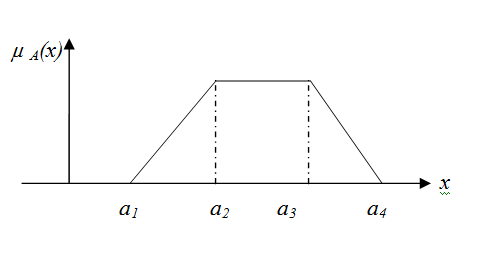
Definition 2. A TpFN is denoted as and is defined by the membership function.
Definition 3. A zero TpFN is defined as a TpFN that exists if
Definition 4. A TpFN is said to be non - negative TpFN if
Definition 5. and be two TpFN s are said to be equal if
2.4 Arithmetic Operation of Trapezoidal Fuzzy Number
For arbitrary TpFNs and and the arithmetic operations on the TpFNs are defined by
In particular, for any two TpFNs and , we define
I. Addition (+):
II. Subtraction (-):
III. Multiplication ( ) :
IV. Division ( ):
Theorem 1. Let and be two TpFNs. The multiplication of and denoted by need not be a TpFN. However, the following property provides an approximation formula to regard as a TpFN.
Theorem 2. Let and be two TpFNs. The is also a TpFN approximately.
3. The TOPSIS Method
People whose gender identity, gender expression, or behavior deviates from what is commonly associated with the sex to which they were assigned at birth are collectively referred to as transgender. A person's internal perception of being male, female, or something different is referred to as their gender identity. The way someone displays their gender identity to others through behavior, attire, hairstyles, voice, physical attributes, etc. is referred to as gender expression. A transgender is one who is in between categories of gender. They are these people by the combination of both male and female. They are called such as transgender, multi-transgender, third gender. But this third gender is not accepted in society anywhere in the world. It is due to different activities such as the way of behavior, the way of talking, hairstyle, dressing, etc. Parents, colleagues, friends, and society should give equal rights in all activities. An internal sense of being male or female in terms of gender expression is called gender identity. People whose gender expression or gender identity (how they see themselves as male or female) differs from what is often associated with their natal sex are referred to as transgender. Many transgender people live as members of the other gender either full-time or part-time. Transgender refers, in general, to any individual whose identity, appearance, or conduct deviates from accepted gender norms. However, not everyone who exhibits gender-atypical behavior or appearance will identify as transgender.
Being biologically male or female is referred to as "sex." The term "gender" is frequently used to describe the behaviors, interactions, and self-perceptions that are associated with boys and girls. Certain features of gender may not be culturally universal, despite aspects of biological sex being universal. People who identify as transgender and who live or aspire to live as members of the gender opposite to their birth sex are known as transsexuals. Transsexual guys, also known as Female-to-Male (FTM) transsexuals, are biological females who want to live and be accepted as men. Male-to-Female (MTF) transsexuals, often known as transsexual women, are biological guys who want to live and be accepted as women. Transsexuals typically seek out medical procedures, such as hormone therapy and surgery, to achieve the greatest degree of physical conformity to their desired gender. Sex reassignment or gender reassignment is the term used to describe the process of changing one's gender identity.
The reasons behind certain people's gender identity are not universally understood. Any straightforward or comprehensive explanation is refuted by the multiplicity of transgender expression. It is challenging to determine with precision how often transgender individuals are in Western nations. Up to 2-3% of biological males at least occasionally participate in cross-dressing. Approximately 1 in 10,000 biological males and 1 in 30,000 biological females are estimated to be transsexuals at this time. The same mental health issues that affect non-transgender people also affect transgender people. However, transgender people may be more susceptible to some mental health issues because of the stigma, prejudice, and internal conflict they face. Transgender individuals may experience mental health difficulties that are made worse by discrimination, a lack of social support system, and insufficient access to care; on the other hand, peer, family, and professional support may serve as buffering factors.
Sex generally refers to anatomy and biology such as male or female, whereas gender refers to the qualities and behaviors society expects from a boy or girl, a man or woman. The gonads, genitalia, reproductive organs, and sex chromosomes are all parts of a person's physical and biological sex. Gender, on the other hand, refers to more sociological facets of an individual's identity, such as how they interact with others and feel about themselves. It is a phrase used to characterize both men and women who identify as belonging to one sex but who believe their true gender is the other. Although the existence of transgender people remains uncertain, the term "Transgender" gained widespread usage in the 1970s. Initially limited to anyone desiring to live as someone of a different gender without undergoing reassignment surgery. People who identify as transgender might be of any age or gender, but they are defined by their looks, traits, or actions that defy conventional notions of what men and women are "Supposed" to be. Though not restricted to transsexuals, India is home to a variety of sociocultural transgender identities, including jogtas, jogappas, shiv shaktis, Aradhis, Sakhi, and others. These sociocultural groups may not include all transgender people, though; some may identify as transgender on their own and not be a part of any group. Transgender people in India face a variety of issues. So far, these communities perceive that they have been excluded from effectively participating in social and cultural life; economy; politics, and decision-making processes.
They are deprived of many of the rights and privileges which other persons enjoy as citizens of India. The rights of transgender people are severely limited. These include the inability to participate in social and cultural activities, rejection from family and society, restricted access to public spaces, health care, education, and employment opportunities, and a host of other human rights like the ability to vote, apply for a passport, drive a license, vote, and contest elections. Jobs for transgender people are quite scarce. Transgender people are not allowed in public restrooms or restroom facilities. Lack of access to restrooms and public areas serves as an example of the discrimination transgender people experience when trying to use all facilities and amenities. In hospitals, schools, and prisons, they deal with comparable issues.
In this section, we have used a fuzzy TOPSIS method to rank the problems faced by Transgenders. Based on the rank of the preference order, the gathered data are described in terms of TpFNs to determine the positive and NISs. The suggested approach gives us a practical means of addressing the fuzzy multiple attribute group decision-making problem. Therefore, an extension of the TOPSIS method is proposed using a TpFN, where the correlation information among factors provided by experts is in the form of uncertain linguistic terms and is transformed into a TpFN. At the conclusion of this paper, an example is provided to illustrate the steps involved in the suggested method.
To create a process for resolving multi-person, MCDM issues in a fuzzy environment, we expanded the TOPSIS concept. Taking into account the fuzziness of the decision-making process and group decision-making data.
The survey was based on the following questionnaire:
I. What is your perspective on Transgender.
II. When did you realize that you aren’t the person with the sex that people claimed you were.
III. Are you happy about what you are right now.
IV. Is the society accepting you are right now.
V. Have you ever been humiliated (explain if any).
VI. If you ever have a chance to change your gender will you(If yes its miserable).
VII. What is your sex preference.
VIII. Are you financially supported.
IX. If you can will you give birth to a baby.
X. How would you react if your baby grew up as a Tran’s man or a Tran’s woman.
XI. What would you say to the transgender out there.
XII. Why do you feel that you are a victim.
XIII. Why do you give up and beg, why do you accept crimination.
XIV. Why don’t you try to make people understand your nature.
XV. Why do you take humiliation personally and not other personal immaturity.
XVI. Have you tried to adopt children and do you think talent requires gender qualification.
3.1 Causes for the Problems of Transgender in Chennai-India
C1 – Parents.
C2 – Employers.
C3 – Public.
C4 - NGO’s.
In this study, we consider the following problems faced by transgender based on our interview and survey. PC1 - Lack of education.
PC2 – Poverty.
PC3 - Identity and gender.
PC4 -Harassment.
PC5 – Unemployment.
PC6 - Hormones defects.
PC7 - Pressurized to engage in sex work.
PC8 - Affected by HIV/AIDS.
PC9 – Depression.
PC10 - Human rights.
3.2 Proposed Method to Analyze the Problems of Cause and Effect of Transgenders
One of the well-known traditional MCDM techniques, the TOPSIS, is based on the premise that the option of choice should be the one that is closest to the PIS and the furthest from the NIS. The weights of the criteria and performance ratings in the TOPSIS procedure are provided as clear values, with additional developments by Yoon [6] and Lai et al. [9].
A group of alternatives is compared using this compensatory aggregation approach, which determines weights for each criterion, normalizes scores for each criterion, and computes the geometric distance between each alternative and the ideal alternative—the option with the highest score for each criterion.
The enhanced TOPSIS method:
Here we follow the 10 steps for calculations.
Step 1. Construct a multi-criteria decision matrix, using the collected data.
According to TOPSIS, we have n qualities or criteria, m choices (options), and the score of each option about each criterion. Let represent the judgment on the intensity of the correlation between factors and provided by an expert . If there are k members in the decision group, the significance of the criteria and the ranking of the alternatives in relation to each criterion can be computed as
, where , are the ratings and the
importance weight of the k th decision maker.
An MCDM problem can be concisely expressed in matrix format.
An uncertain direct–relation matrix is:
Matrix 1: direct–relation matrix.
, where and are linguistic variables. These linguistic variables can be described
by TpFNs as and
In this step prepare an (n×n) Fuzzymatrix each corresponding to experts and its elements are obtained. The fuzzy matrix is called the assessment data matrix whose linguistic terms are “Very Low” (VL), “Low” (L), “Medium” (M), “High” (H), and “Very High” (VH) respectively.
Step 2. Generating the fuzzy linguistic scale table.
The pair-wise comparison scale may be designated five levels, where the scores 0.125, 0.250, 0.4375, 0.625, and 0.8125 represent ‘‘Very low influence’’, ‘‘Low influence”, “Medium influence”, “High influence’’ and “Very high influence” respectively.
Table 1. The fuzzy linguistic scale values.
This table is shown in the PDF version of the article.
These linguistic variables can be expressed in positive triangular fuzzy numbers as Table 1.
Step 3. Construct the initial direct-relation matrix Y.
The expert prepares sets of pair-wise comparisons in terms of effects and direction between criteria. Then the initial data can be obtained as the direct-relation matrix which is an n × n matrix Y where each element of xij is denoted as the degree in which the criterion I affects the criterion j. In this step, we will see the linguistic variables are ‘‘Very low influence’’, ‘‘Low influence”, “Medium influence”, “High influence’’ and “Very high influence” respectively, and show the positive trapezoidal numbers .
Matrix 2: initial direct-relation matrix.
TOPSIS assumes that we have m alternatives (options) and n attributes/criteria and we have the score of each option concerning each criterion. Let yij score of option I with respect to criterion j. We have a matrix matrix.
For this step, we will realize that to frame the initial direct relation matrix by using the linguistic scale table. The initial direct-relation matrix is n x n matrix obtained by pair-wise comparisons in terms of influences and directions between criteria, in which yij is denoted as the degree to which the criterion I affects the criterion j, i.e., By using TpFNs (0, 0, 0.25, 0.25) (0, 0.25, 0.25, 0.50), (0.25, 0.25, 0.5, 0.75), (0.25, 0.5, 0.75,1), (0.5, 0.75, 1, 1) respectively prepare the table.
Step 4. Prepare the generalized direct-relation matrix.
By using TpFNs prepare the generalized direct-relation matrix among the various shapes of fuzzy numbers, TpFN is the most popular one. A TpFN is a fuzzy number represented with four points.
If we note that then and are calculated by
Step 5. Normalizing the matrix
The normalized decision matrix, In order to make the different criteria comparable, the decision matrix X needs to be normalized, resulting in the Normalize the decision matrix using the equation below:
, where is the normalized criteria/attribute value /rating.
Step 6. Calculate the weighted normalized decision matrix.
The value can also be demonstrated as , where I =1, 2,..., m; j =1,2,...n. Here the use of is the
relative weight of the jth criterion or attribute and gives an expert to define the matrix’s elements
and weights of criteria. Thus, in a group decision environment with experts, the importance of the criteria and the rating of alternatives with respect to each criterion can be calculated as the weighted normalized decision matrix is established.
Steps 6a and 6b. Determine the Positive-ideal and Negative-ideal solutions:
In this method, two artificial alternatives are hypothesized.
Positive ideal alternative: the one which has the best level for all attributes considered.
Negative Ideal alternative: the one which has the worst attribute values.
TOPSIS selects the alternative that is the closest to the ideal solution and farthest from the negative ideal alternative where and are the sets of benefit criteria/attributes and cost criteria/attributes, respectively. It is easy to see that applying the Range method to standardize the data can help to determine the numerical values of the positive ideal and NIS quickly.
Step 7. The separation of each alternative from the PIS
The separation of each alternative from the PIS is given as .
Step 8. The separation of each alternative from the NIS Similarly, the separation of each alternative from the ideal solution is given as
Step 9. Calculate the relative closeness to the Ideal solution.
The relative closeness of the ith alternative with respect to the ideal solution is defined as
. The relative closeness of the and then clearly .
Step 10. Find the rank preference order.
Choose an alternative with the maximum or rank alternatives according to in descending order. The rank of the preference order is the alternatives according to the relative closeness to the ideal solution. The best alternative is the one with the greatest relative closeness to the ideal solution.
4. Numerical Example
Step 1. Prepare the assessment data matrix.
In this step prepare an fuzzy matrix Z, where each entry represents the experts’ opinion corresponding to and with TpFNs and its elements are obtained. The fuzzy matrix Z is called the assessment data matrix by using linguistic variables VL, L, M, VH, and H respectively.
Matrix 3: assessment data matrix Z.
For the above table C1, C2, C3, C4 denote the criteria of the problems facing the transgender through Parents, Employers, Transgender, and NGO leaders.
Step 2. Generating the linguistic scale table.
For this step, we frame the linguistic scale from the following table.
Table 2. Linguistic table.
This table is shown in the PDF version of the article.
Step 3. Prepare the initial direct-relation matrix Y.
By using TpFNs (0,0,0.25,0.25) (0,0.25,0.25,0.50), (0.25,0.25, 0.5, 0.75), (0.25, 0.5, 0.75,1), (0.5, 0.75, 1, 1) respectively prepare the following table. The importance weights of various criteria and the ratings of qualitative criteria are considered linguistic variables.
Matrix 4: the initial direct relation matrix Y.
Step 4. Prepare the generalized direct-relation matrix X.
By using triangular fuzzy numbers prepare the generalized direct-relation matrix among the various shapes of fuzzy numbers.
Matrix 5: the generalized direct-relation matrix X.
Step 5. Prepare the Normalization matrix
Normalization is performed using the following,
The group uncertain direct-relation matrix is changed into the normalized uncertain direct-relation matrix .
If we note that then and are expressed by
where and
. We decompose the matrix into four crisp value matrices and as follows.
where is the normalized criteria/attribute value/rating.
Matrix 6: normalization matrix
Step 6. Calculate the weighted normalized decision matrix.
The value is calculated as .
Matrix 7: weighted normalized decision matrix
For the above table the important weight of each criterion can be considered as (0.1), (0.4), (0.2), and (0.3).
Step 6a. Prepare a PIS to the above table.
Given = {0.03335, 0.13338, 0.06669, 0.10004}.
Step 6b. Prepare the NIS of the above table.
Given = {0.00513, 0.02052, 0.02052, 0.01539}.
Step 7. The separation of each alternative from the PIS.
Table 3. Positive ideal solution.
This table is shown in the PDF version of the article.
Step 8. The separation of each alternative from the NIS.
Table 4. Negative ideal solution.
This table is shown in the PDF version of the article.
Step 9. The separation of each alternative from the and ideal solutions
Table 5. Separation of each alternative.
This table is shown in the PDF version of the article.
Step 10. Find the rank preference order.
Choose an alternative with the maximum or rank alternatives according to in descending order. The best alternative is the one with the greatest relative closeness to the ideal solution.
This TOPSIS method gives the ranking for the attributes are 0.160822> 0.200489> 0.21204> 0.222695> 0.222864> 0.225211> 0.238702> 0.2563> 0.257815> 0.258072. This clearly shows that the attributes are PC9-depression, PC3- harassment, PC7- pressurized to engage in sex work, PC6-hormone defects, PC8- affected by HIV/AIDS, PC4-harassment, PC10-human rights, PC5-unemployment, PC2-poverty, PC1-lack of education are the attributes of the ranking of the fuzzy-TOPSIS methods as shown in the following Fig. 1.
Ranking of the Problems of Transgender
0.2580720.2578150.2004890.225211 0.2563 0.222695 0.21204 0.2228640.1608220.238702
5. Discussion
In light of the above-mentioned discussion through the fuzzy TOPSIS approach, the diagram is constructed to show the ranking of the relationship of transgender. From these calculations, we conclude that the evaluation criteria were visual, including the categories C9, C3, C7, C6, C8, C4, C10, C5, C2, C1 are factors that are responsible for the problems of the Transgender. We have considered ten different sub-strategies including lack of education, poverty, identity and gender, harassment, unemployment, hormone defects, pressure to engage in sex work, affected by HIV/AIDS, depression, and human rights are attributes of the ranking of the fuzzy-TOPSIS methods and rank them based on fuzzy -TOPSIS technique. It is clear that transgender is facing a lot of problems from the simplest personal relations to the most general social ignorance of the society. From these calculations, we conclude that the ranking of the attributes is PC9>PC3>PC7>PC6>PC8>PC4>PC10>PC5>PC2>PC1 to the relative closeness to the ideal solution. This paper applies a decision-making method to rank the problems of Transgender. Here we made four criteria and eight alternatives were used to analyze using the TOPSIS method. This method suggests that “PC9- depression” is the main cause of our problem. We conclude that the evaluation criteria showed that, including the categories C9, C3, C7, C6, C8, C4, C10, C5, C2 and C1 are factors that are responsible for problems of transgender. From this, we understand that the transgender confronts so many problems in day-to-day life. However, C9-depression is the basic cause of this research calculation. Because depression causes a person to indulge in criminal activities and even drive them to end their own lives. If this devastating cause of depression is not addressed properly, the effects on their community will not progress.
6. Conclusion
The TOPSIS is a multi-criteria decision analysis method for ranking different alternatives based on various criteria It is argued that if a fuzzy MCDM problem is defuzzified into a crisp one in initial steps, then the advantage of collecting fuzzy data becomes unapparent. Based on this fact, we have developed a fuzzy TOPSIS method for dealing with problems, in which criteria values are TpFNs. The proposed fuzzy TOPSIS combines the method for crisp MCDM with the fuzzy principles and performs defuzzification. In the final step of decision analysis, the rank was examined and the results were demonstrated. The n × n fuzzy assessment data matrix Z is prepared in matrix 1. The linguistic scale values are represented by TpFNs as in
Funding Statement
The authors received no specific funding for this study.
Author Contributions
Study conception and design: Saraswathi; Literature review and datacollection: Saraswathi and Nedumaran; Analysis and interpretation of literature: Saraswathi; Visualization and table representation: Saraswathi; Draft manuscript preparation: Saraswathi; Critical revision of the manuscript: Saraswathi and Nedumaran. All authors reviewed the results and approved the final version of the manuscript.
Consent for Publication
All authors have provided their consent for the publication of this manuscript.
Ethics Approval
This article does not contain any studies with human participants or animals performed by any of the authors.
Data Availability
All data supporting the reported findings in this research paper are provided within the manuscript.
Conflicts of Interest
The authors declare that they do not have any conflict of interest.
References
- [1] Hwang, C. L., & Yoon, K. (1981). Methods for multiple attribute decision making. In Multiple attribute decision making: methods and applications a state-of-the-art survey (pp. 58–191). Springer. https://doi.org/10.1007/978-3-642-48318-9_3
- [2] Kwong, C. K., & Tam, S. M. (2002). Case-based reasoning approach to concurrent design of low power transformers. Journal of materials processing technology, 128(1–3), 136–141. https://doi.org/10.1016/S0924-0136(02)00440-5
- [3] Milani, A. S., Shanian, A., Madoliat, R., & Nemes, J. A. (2005). The effect of normalization norms in multiple attribute decision making models: a case study in gear material selection. Structural and multidisciplinary optimization, 29, 312–318. https://doi.org/10.1007/s00158-004-0473-1
- [4] Srdjevic, B., Medeiros, Y. D. P., & Faria, A. S. (2004). An objective multi-criteria evaluation of water management scenarios. Water resources management, 18, 35–54. https://doi.org/10.1023/B:WARM.0000015348.88832.52
- [5] Yang, T., & Chou, P. (2005). Solving a multiresponse simulation-optimization problem with discrete variables using a multiple-attribute decision-making method. Mathematics and computers in simulation, 68(1), 9–21. https://doi.org/10.1016/j.matcom.2004.09.004
- [6] Yoon, K., & Hwang, C. L. (1985). Manufacturing plant location analysis by multiple attribute decision making: Part I—single-plant strategy. International journal of production research, 23(2), 345–359. https://doi.org/10.1080/00207548508904712
- [7] Janic, M. (2003). Multicriteria evaluation of high-speed rail, transrapid maglev and air passenger transport in Europe. Transportation planning and technology, 26(6), 491–512. https://doi.org/10.1080/0308106032000167373
- [8] Chen, M. F., & Tzeng, G. H. (2004). Combining grey relation and TOPSIS concepts for selecting an expatriate host country. Mathematical and computer modelling, 40(13), 1473–1490. https://doi.org/10.1016/j.mcm.2005.01.006
- [9] Lai, Y. J., Liu, T. Y., & Hwang, C. L. (1994). TOPSIS for MODM. European journal of operational research, 76(3), 486–500. https://doi.org/10.1016/0377-2217(94)90282-8
- [10] Shih, H. S., Lin, W. Y., & Lee, E. S. (2001). Group decision making for TOPSIS. Proceedings joint 9th IFSA world congress and 20th NAFIPS international conference (Cat. No. 01TH8569) (pp. 2712-2717). IEEE. https://doi.org/10.1109/NAFIPS.2001.943653
- [11] Kim, G., Park, C. S., & Yoon, K. P. (1997). Identifying investment opportunities for advanced manufacturing systems with comparative-integrated performance measurement. International journal of production economics, 50(1), 23–33. https://doi.org/10.1016/S0925-5273(97)00014-5
- [12] Wang, Y. J., & Lee, H. S. (2007). Generalizing TOPSIS for fuzzy multiple-criteria group decision-making. Computers and mathematics with applications, 53(11), 1762–1772. https://doi.org/10.1016/j.camwa.2006.08.037
- [13] Ashtiani, B., Haghighirad, F., Makui, A., & ali Montazer, G. (2009). Extension of fuzzy TOPSIS method based on interval-valued fuzzy sets. Applied soft computing, 9(2), 457–461. https://doi.org/10.1016/j.asoc.2008.05.005
- [14] Amiri-Aref, M., Javadian, N., & Kazemi, M. (2012). A new fuzzy positive and negative ideal solution for fuzzy TOPSIS. WSEAS transactions on circuits and systems, 11(3), 92–103. https://wseas.com/journals/cas/2012/53-497.pdf
- [15] Phaneendra Kiran, C., Clement, S., & Agrawal, V. P. (2011). Coding, evaluation and optimal selection of a mechatronic system. Expert systems with applications, 38(8), 9704–9712. https://doi.org/10.1016/j.eswa.2011.01.171
- [16] Gallego-Ayala, J. (2012). Selecting irrigation water pricing alternatives using a multi-methodological approach. Mathematical and computer modelling, 55(3–4), 861–883. https://doi.org/10.1016/j.mcm.2011.09.014
- [17] Saraswathi, A., Prakash, A. P., & Ganesan, K. (2016). A fuzzy topsis method for solving mcdm problems under uncertainty. Global journal of pure and applied mathematics (GJPAM), 12(1), 2016. https://www.researchgate.net/profile/Saraswathi/publication/298072495_A_fuzzy_TOPSIS_method_for_solvi ng_MCDM_problems_under_uncertainty/links/674f569a3d17281c7df7752d/A-fuzzy-TOPSIS-method-for-solving-MCDM-problems-under-uncertainty.pdf
- [18] Anand, M. C. J., & Devadoss, A. V. (2013). Application of Topsis method to analyze causes of suicide thought in domestic violence. International journal of computing algorithm, 2(2), 354–362. https://B2n.ir/zy8575
- [19] Chen, C. T. (2000). Extensions of the TOPSIS for group decision-making under fuzzy environment. Fuzzy sets and systems, 114(1), 1–9. https://doi.org/10.1016/S0165-0114(97)00377-1
- [20] Lo, C. C., Chen, D. Y., Tsai, C. F., & Chao, K. M. (2010). Service selection based on fuzzy TOPSIS method. 2010 IEEE 24th international conference on advanced information networking and applications workshops (pp. 367-372). IEEE. https://doi.org/10.1109/WAINA.2010.117
- [21] Ding, J. F. (2011). An integrated fuzzy TOPSIS method for ranking alternatives and its application. Journal of marine science and technology, 19(4), 2. https://jmstt.ntou.edu.tw/journal/vol19/iss4/2
- [22] Jahanshahloo, G. R., Lotfi, F. H., & Izadikhah, M. (2006). Extension of the TOPSIS method for decision-making problems with fuzzy data. Applied mathematics and computation, 181(2), 1544–1551. https://doi.org/10.1016/j.amc.2006.02.057
- [23] Aly, M. F., Attia, H. a, & Mohammed, A. M. (2013). Integrated fuzzy (GMM) -TOPSIS model for best design concept and material selection process. International journal of innovative research in science, engineering and technology, 2(11), 6464–6486. https://www.fayoum.edu.eg/English/Eng/Mechanical/pdf/DrMohamedF4.pdf
- [24] Papageorgiou, E. I., & Stylios, C. D. (2008). Fuzzy cognitive maps. Handbook of granular computing, 24(1), 755–
- [774] https://doi.org/10.1002/9780470724163.ch34
- [25] Wu, C. S., Lin, C. T., & Lee, C. (2010). Optimal marketing strategy: A decision-making with ANP and TOPSIS. International journal of production economics, 127(1), 190–196. https://doi.org/10.1016/j.ijpe.2010.05.013
- [26] Kannan, V., Appasamy, S., & Kandasamy, G. (2022). Comparative study of fuzzy floyd warshall algorithm and the fuzzy rectangular algorithm to find the shortest path. AIP conference proceedings (Vol. 2516). AIP Publishing. https://doi.org/10.1063/5.0110337
- [27] Vidhya, K., & Saraswathi, A. (2023). A novel method for finding the shortest path with two objectives under trapezoidal intuitionistic fuzzy arc costs. International journal of analysis and applications, 21, 121. https://doi.org/10.28924/2291-8639-21-2023-121
- [28] Prakash, Y., & Appasamy, S. (2023). Optimal solution for fully spherical fuzzy linear programming problem. Mathematical modelling of engineering problems, 10(5), 1611–1618. https://doi.org/10.18280/mmep.100511
- [29] Saraswathi, A. (2019). A fuzzy-trapezoidal dematel approach method for solving decision making problems under uncertainty. AIP conference proceedings (Vol. 2112, p. 20076). AIP Publishing LLC. https://doi.org/10.1063/1.5112261
- [30] Dharmaraj, B., & Appasamy, S. (2023). Application of a modified gauss elimination technique for separable fuzzy nonlinear programming problems. Mathematical modelling of engineering problems, 10(4), 1481–1486. https://doi.org/10.18280/mmep.100445
- [31] Vidhya, K., & Saraswathi, A. (2023). An improved A∗ search algorithm for the shortest path under interval-valued Pythagorean fuzzy environment. Granular computing, 8(2), 241–251. https://doi.org/10.1007/s41066-022-00326-1
- [32] Saraswathi, A., & Mahalakshmi, S. (2024). A new approach for solving the minimal flow, shortest route, maximal flow and the critical path using network. International journal of system design and information processing, 12(2), 263–276. https://B2n.ir/fn1061
- [33] Saraswathi, A. (2024). A study on triangular fuzzy clustering model under uncertainty. Uncertainty discourse and applications, 1(1), 20–28. https://doi.org/10.48313/uda.v1i1.19