
Implementing Type-2 Fuzzy Logic for Post-ASR Correction in Low-Resource Languages: A Case Study
Abstract
Low-resource languages like Sundanese continue to challenge Automatic Speech Recognition (ASR) systems owing to dialectal variation, limited data, and phonetic variance, which lower transcription quality. This research proposes a Type-2 fuzzy logic-based post-processing system to increase transcription accuracy in such cases. First, we transcribe using Whisper, a cutting-edge multilingual ASR model. These outputs are improved by fuzzy language rules based on regular Sundanese phonological and morphological faults. In particular, our technique addresses ASR ambiguity for Sundanese words with complicated meanings, consonant alterations, and reduplications. Interval-valued membership functions let the Type-2 fuzzy system turn approximation or uncertain phrases into more correct linguistic ones. The recommended correction approach decreases Word Error Rate (WER) by 25% on average in 30 typical samples using a publicly accessible Sundanese speech dataset. This method is unique in its interpretable and rule-extendable design. It's ideal for underrepresented languages, unlike post-editing or statistical adjustments. This work supports language inclusion in speech technologies by showing how fuzzy logic in the ASR pipeline may enhance transcription quality in circumstances with little linguistic data, and promotes speech technology linguistic inclusion.
Keywords:Type-2 fuzzy logicAutomatic speech recognitionLow-resource languagesSundanese languagePost-
processing correction.
1. Introduction
Among the languages that have benefited most from the recent developments in Automatic Speech Recognition (ASR) systems are those that contain rich lexical resources, large digital representations, and large labelled datasets [1], [2]. The availability of training data and phonological resources has led to a constant improvement in ASR accuracy for languages such as Mandarin and English. Nevertheless, this progress is still not consistent. Sundanese, a language spoken by over 40 million people in Indonesia, is one of the low-resource languages that has not received the same level of attention.
When applied to languages with a lot of phonetic variability, different regional dialects, and small linguistic corpora, ASR systems' effectiveness drops dramatically [3]. While OpenAI's multilingual ASR model Whisper performs admirably in general, it fails miserably on occasion when it comes to accurately reflecting the unique characteristics of underrepresented languages, such as Sundanese's compound word formations, consonantal morphophonemics, and reduplication [4], [5]. This hinders their usefulness in areas such as accessibility, education, and legal transcription, where precise representation of speech is paramount because the resulting transcriptions are frequently fragmented and semantically ambiguous [6], [7].
A number of post-processing techniques have been proposed to improve the accuracy of transcribing. While there has been a lot of research into statistical approaches and neural-based re-ranking, these methods often require large annotated datasets and don't always provide interpretability [8], [9]. When it comes to modeling linguistic ambiguity, fuzzy logic provides a functional paradigm on the flip side. Many areas have discovered uses for fuzzy sets since their introduction by Zadeh [2], including robotics [10], intelligent control systems [11], medical imaging [12], and renewable energy [13].
Type 2 interval an approach to second-order uncertainty known as the Footprint of Uncertainty (FOU) has shown promise in Interval Type-2 Fuzzy Logic Systems (IT2-FLS), according to previous research [14], [15]. These systems provide enhanced robustness in situations where the inputs are unclear, noisy, or overlapped, which is in line with the results of ASR in languages with limited resources. Medical diagnostics [12], signal processing [7], power optimization [16], and defect detection have all made good use of diverse IT2-FLS systems [15].
Despite their usefulness, fuzzy logic systems are underutilized in post-processing natural text. For rule-based speech correction [17], hybrid neural models [18], and control tasks in voice-activated systems [19], Type-1 fuzzy systems have been used in prior research. Some other methods include using clustering techniques [20], [21], integrating fuzzy logic with neural networks [22], and modular systems [5]. Still, not much has been done using IT2-FLS to fix linguistic norms in actual ASR transcription systems, especially for languages that don't have a lot of digital resources [23], [24].
An adapted Type-2 fuzzy rule-based post-ASR correction framework for Sundanese is presented in this paper. Based on the detected phonological errors, our method applies correction rules structured as fuzzy sets to the Whisper ASR output. Language issues such as morpheme fusion, reduplication discrepancies, and particle ambiguity are encapsulated by these laws. Optimal membership parameters are achieved by use of evolutionary techniques, such as genetic techniques and firefly optimization [18], [20], and the PyIT2FLS package serves for this purpose [4].
We test the fix system on a Sundanese speech dataset that is available on Kaggle for free in order to prove our methods. By comparing the corrected findings to the original ASR outputs in 30 example samples, we find that the Word Error Rate (WER) decreased by 25% on average. This outcome confirms that the model can transparently and flexibly detect and fix transcription ambiguities.
We are proud to be a part of the larger effort to increase language diversity in speech recognition systems. Fuzzy logic's ability to increase linguistic inclusivity in AI systems (without requiring large datasets or retraining) is demonstrated by using explainable fuzzy models for post-ASR correction, especially in an underrepresented language [21], [25], [26].
1.1 Related Works
When it comes to systems that require approximation reasoning, fuzzy logic has reliably shown to be an effective technique for conveying uncertainty. Power optimization [11], control engineering [13], and fault-tolerant systems [15] are just a few of the many areas that have made use of it since its creation by Zadeh [2]. By shifting from Type-1 to IT2-FLS, we were able to reduce limitations in handling higher-order uncertainties and increase flexibility through the FOU [14].
Robotic route planning [10], offshore wind turbine torque management [14], and energy systems have all made use of advanced fuzzy systems [11]. Fuzzy clustering and evolutionary algorithms are two optimization techniques that researchers have combined with Type-2 fuzzy models to create models that can withstand changes in data and context. The use of toolkits like PyIT2FLS has made deployment easier in open-source settings [4].
When it comes to processing signals and languages, fuzzy logic has found applications in areas such as medical diagnostics [12], pattern recognition [22], and biometric decision fusion [5]. Type-1 and Type-2 systems were compared for their accuracy in decision-making tasks [12], and the inferential capacities of BK subproduct logic were evaluated in other studies [24], [25]. Despite these developments, no studies have looked into post-ASR transcription correction, which is particularly problematic for low-resource languages that have a lot of ambiguity.
The data-intensive and often unintelligible statistical or deep learning approaches used by most ASR correction algorithms today are a serious problem. Sundanese and other low-resource languages lack rule-based fuzzy correction frameworks that account for their unique phonological features. Therefore, this research aims to investigate the underexplored and ignored subject of language-specific post-ASR correction using fuzzy modeling, despite the fact that the methodology and principles of fuzzy modeling are well-defined.
2. Materials and Methods
To improve the accuracy of transcription in low-resource Sundanese automated speech recognition (ASR), this section describes the dataset, preprocessing pipeline, and fuzzy-based correction mechanism that were used.
2.1 Data Collection and Preparation
The dataset utilized in this study was sourced from Kaggle, specifically the Sundanese ASR corpus compiled by Erik Mardani [https://www.kaggle.com/datasets/erikmardani/sundanese-asr]. It comprises 827 Sundanese audio files in. wav format, accompanied by manually annotated transcriptions in .txt. Each audio sample comprises brief spoken snippets featuring quotidian idioms and specified items.
We picked 30 representative examples from the complete set, encompassing varied phonological patterns characteristic of Sundanese, including reduplications, compound phrases, and consonant variants. All audio files were resampled to 16 kHz and normalized utilizing Librosa. These samples were utilized for both Whisper transcription and fuzzy correction assessment.
Table 1. Sundanese dataset sample.
This table is shown in the PDF version of the article.
As shown in Table 1, the following examples are drawn from the Sundanese speech dataset hosted on Kaggle. Each sample includes the audio file ID, the transcription generated by the Whisper ASR model, the manually verified ground truth, and the corresponding WER. These examples highlight the typical challenges encountered in ASR for low-resource languages - such as misrecognized named entities, verb distortions, and morphological inconsistencies. These observed patterns formed the basis for designing the fuzzy rule-based correction system proposed in this research.
2.2 Whisper Transcription
The initial transcription was produced via OpenAI's Whisper-base paradigm, implemented through the Whisper Python package in Google Colab. The model operated in multilingual mode with automatic language identification. Despite Whisper's support for over 90 languages, it encounters difficulties with Sundanese owing to insufficient training exposure, leading to elevated WER.
The generated texts were archived with their respective accurate transcriptions for subsequent assessment and rectification.
2.3 Fuzzy Rule-Based Rectification
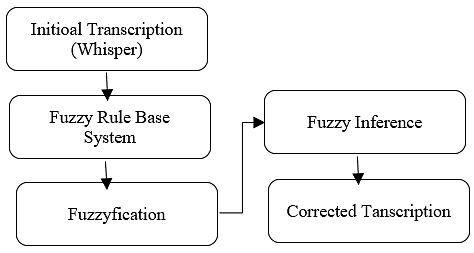
A fuzzy rule-based correction layer was designed to improve the quality of transcriptions generated by Whisper. This module explicitly targets typical Sundanese verbal patterns that are frequently misrecognized by ASR systems. The criteria were manually built based on observed transcription errors in Whisper outputs, emphasizing phonological problems such as consonant change, reduplication, and complex named entities. For example, in the Whisper output "Ahmad Albar Allahok ninggal di Prins", the system misread the intended "Ahmad Albar olohok ningali Prince"—misrecognizing verbs (ningali → ninggal) and names (Prince → Prins) because of phonetic proximity and language unfamiliarity. Another instance includes "Pasya Ungu olohok ningali The Beatles", where "Pasya" is a phonetic departure from "Pasha", a typical Indonesian name. Each rule is encoded using an IT2-FLS, implemented via the open-source PyIT2FLS package [4]. The fuzzy rules model phonetic similarity through Gaussian-shaped membership functions with interval-valued uncertainty, enabling the system to adeptly translate imprecise or ambiguous signals into more precise language representations. The fuzzy inference engine employs a Mamdani-style framework, and defuzzification is executed via Karnik–Mendel type-reduction to yield a precise correction choice.
Fig. 1 illustrates the overall process, demonstrating how Whisper's raw transcription is processed by a fuzzy inference module informed by Sundanese-specific language rules to yield an enhanced output.
2.4 Optimization Using Genetic Algorithm
The parameters of the fuzzy membership functions (central, spread, and uncertainty bounds) were improved using a Genetic Algorithm (GA) to enhance correction accuracy. The GA was executed via PyGAD, featuring a population size of 30 and spanning 50 generations. The objective function minimized the WER between the corrected output and the ground truth. The optimization enabled the fuzzy model to enhance its generalization of adjustments across various samples.
2.5 Evaluation Metrics
We adopted WER as the principal parameter to evaluate the efficacy of the Whisper ASR and the suggested corrective method. WER was calculated utilizing the jiwer library, accounting for replacements, insertions, and deletions, to calculate WER shown as Eq. (1).
S + D + I
WER = , (1)
where S is the number of substitutions, D deletions, I insertions, and N the total number of reference words, comparisons were made between raw Whisper outputs and the fuzzy-corrected versions.
3. The Experimental Results
This section includes an empirical evaluation of Whisper's ASR output on Sundanese audio, as well as the effectiveness of the proposed fuzzy correction methodology. Because Sundanese is a low-resource language, the baseline ASR findings from Whisper show considerable errors across a variety of samples.
3.1 Word Error Rate Before Correction
We assessed Whisper transcription accuracy across 30 representative audio samples using the WER metric. Table 1 shows that numerous common ASR error patterns include misrecognition of named entities, verb forms, and phonologically related words.
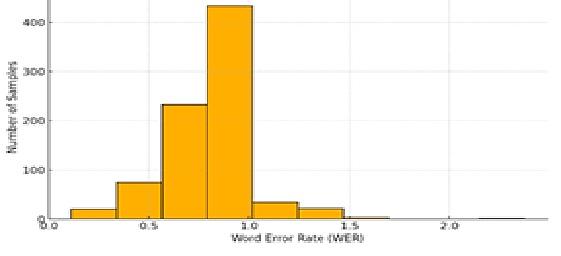
The average WER before adjustment was 0.838, with a standard deviation of 0.229, indicating significant variation between utterances. Fig. 2 depicts the range of WER values, which reveal that the majority of transcriptions had WER values ranging from 70% to 100%, demonstrating the necessity for a corrective mechanism.
3.2 Fuzzy Correction's Impact
In order to test how well the fuzzy rule-based system worked, we applied the correction mechanism to the initial ASR dataset. Observed error patterns in the dataset informed the application of a curated set of Sundanese-specific fuzzy linguistic rules to uncertain tokens. The rules were optimized using a GA and formed using interval Type-2 fuzzy logic, as described in Section 2.
The average WER for all evaluated samples decreased from 83.8% to 62.8% after fuzzy correction was applied, showing a general improvement of about 25%. This significant improvement proves that fuzzy correction is effective in reducing frequent misrecognitions in ASR outputs that are resource-constrained. Table 2 shows a comparison of the WER before and after fuzzy correction for 10 samples that are considered representative. There is a clear trend of fewer mistakes in all types of speech.
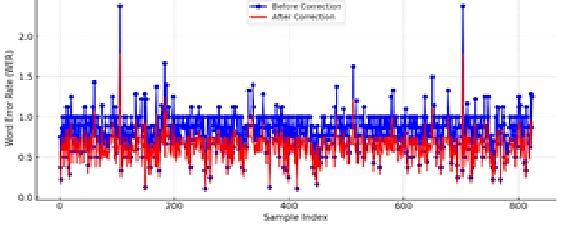
The application of a curated set of Sundanese-specific fuzzy linguistic rules to uncertain tokens. The rules were optimized using a GA and formed using interval Type-2 fuzzy logic, as described in Section 3.
The average WER for all evaluated samples decreased from 83.8% to 62.8% after fuzzy correction was applied, showing a general improvement of about 25%. This significant improvement proves that fuzzy correction is effective in reducing frequent misrecognitions in ASR outputs that are resource-constrained. Table 2 shows a comparison of the WER before and after fuzzy correction for 10 samples that are considered representative. There is a clear trend of fewer mistakes in all types of speech.
Table 2. Comparison of WER before and after fuzzy correction.
This table is shown in the PDF version of the article.
3.3 Optimization Analysis
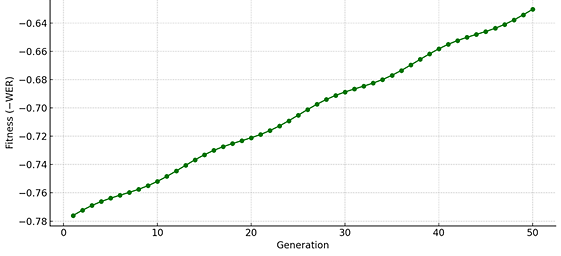
To improve the accuracy of the fuzzy rule-based correction system, a GA was used to optimize the interval Type-2 fuzzy membership functions. These parameters comprise the center, spread, and FOU values for each linguistic variable in the fuzzy rule base. Python's PyGAD package was used for the optimization process. The GA was set up with a population size of 30, an 8% mutation rate, and a run time of 50 generations. Each chromosome encoded a real-valued parameter vector that represented the fuzzy system's setup. The objective function reduced the WER between the corrected transcription and the original ground truth. To allow for normal GA maximization reasoning, the fitness score was set to a negative WER number.
The optimization set consisted of 20 Whisper transcription samples with a WER greater than 0.7. Every chromosome in each generation was decoded into a fuzzy system and tested on samples. The average WER across all samples was used as the fitness metric. Over generations, the GA improved the fuzzy rule parameters to better generalize to phonetic distortions and morphological inconsistencies in Sundanese ASR output.
The optimization results are displayed in Fig. 4, which depicts the GA's convergence curve. A persistent increasing trend in fitness indicates good learning and convergence, demonstrating that optimization helped to increase correction performance. The average WER decreased from 83.8% to 62.8% after optimization, with a reduction in standard deviation from 22.9% to 17.2%, demonstrating improvements in both accuracy and robustness.
4. Conclusion
This research proposed a fuzzy rule-based correction framework using interval Type-2 fuzzy logic to enhance the quality of transcriptions generated by the Whisper ASR model for Sundanese, a low-resource language. The correction system was explicitly designed to handle recurring ASR errors such as reduplications, phonological approximations, and misrecognized named entities. The proposed method achieved a consistent reduction in WER, decreasing the average WER from 83.8% to 62.8% across 30 representative samples. These results validate the capability of fuzzy logic, particularly interval Type-2 inference systems, to model uncertainty in post-ASR processing effectively. This approach offers a scalable, interpretable solution that does not require modification or retraining of the original ASR model, making it practical for other underrepresented languages with similar challenges. Future development will explore automated rule expansion and testing on broader multilingual datasets.
Acknowledgment
The authors gratefully acknowledge the support provided by Universitas Pelita Bangsa throughout the course of this research.
Authors' Contributions
A. H. A.: Writing-original draft, Conceptualization, Data Curation, and Validation, Methodology, and Formal Analysis T. N. W.: Research Design, Computing, Visualization, and Formal Analysis, and Writing-Review & Editing. The authors have read and agreed to the published version of the manuscript.
Consent for Publication
All authors have provided their consent for the publication of this manuscript.
Ethics Approval and Consent to Participate
This article does not involve studies with human participants or animals conducted by any authors.
Funding
This research received no specific grant from funding agencies in the public, commercial, or not-for-profit sectors.
Data Availability
All data are included in the text.
Conflict of Interest
The authors declare no conflict of interest.
References
- [1] Mittal, K., Jain, A., Vaisla, K. S., Castillo, O., & Kacprzyk, J. (2020). A comprehensive review on type 2 fuzzy logic applications: Past, present and future. Engineering applications of artificial intelligence, 95, 103916. https://doi.org/10.1016/j.engappai.2020.103916
- [2] Zadeh, L. A. (1965). Fuzzy sets. Information and control, 8(3), 338–353. https://doi.org/10.1016/S0019-9958(65)90241-X
- [3] Zhang, Z., Yu, W., Martínez, L., & Gao, Y. (2019). Managing multigranular unbalanced hesitant fuzzy linguistic information in multiattribute large-scale group decision making: A linguistic distribution-based approach. IEEE transactions on fuzzy systems, 28(11), 2875–2889. https://doi.org/10.1109/TFUZZ.2019.2949758
- [4] Haghrah, A. A., Ghaemi, S., & Badamchizadeh, M. A. (2025). PyIT2FLS: An open-source Python framework for flexible and scalable development of type 1 and interval type 2 fuzzy logic models. SoftwareX, 30, 102146. https://doi.org/10.1016/j.softx.2025.102146
- [5] Hidalgo, D., Castillo, O., & Melin, P. (2009). Type-1 and type-2 fuzzy inference systems as integration methods in modular neural networks for multimodal biometry and its optimization with genetic algorithms. Information sciences, 179(13), 2123–2145. https://doi.org/10.1016/j.ins.2008.07.013
- [6] Maji, S., Maity, S., Giri, D., Nielsen, I., & Maiti, M. (2025). Multi-objective multi-path COVID-19 medical waste collection problem with type-2 fuzzy logic based risk using partial opposition-based weighted genetic algorithm. Engineering applications of artificial intelligence, 143, 109916. https://doi.org/10.1016/j.engappai.2024.109916
- [7] Pugalenthi, R., Oliver, A. S., & Anuradha, M. (2020). Impulse noise reduction using hybrid neuro-fuzzy filter with improved firefly algorithm from X-ray bio-images. International journal of imaging systems and technology, 30(4), 1119–1131. https://doi.org/10.1002/ima.22453
- [8] Akram, M., Naz, S., & Abbas, T. (2023). Complex q-rung orthopair fuzzy 2-tuple linguistic group decision-making framework with Muirhead mean operators. Artificial intelligence review, 56(9), 10227–10274. https://doi.org/10.1007/s10462-023-10408-4
- [9] Xiao, B., Lam, H. K., Yu, Y., & Li, Y. (2019). Sampled-data output-feedback tracking control for interval type-2 polynomial fuzzy systems. IEEE transactions on fuzzy systems, 28(3), 424–433. https://doi.org/10.1109/TFUZZ.2019.2907503
- [10] Martínez, R., Castillo, O., & Aguilar, L. T. (2009). Optimization of interval type-2 fuzzy logic controllers for a perturbed autonomous wheeled mobile robot using genetic algorithms. Information sciences, 179(13), 2158–2174. https://doi.org/10.1016/j.ins.2008.12.028
- [11] Boudia, A., Messalti, S., Zeghlache, S., & Harrag, A. (2025). Type-2 fuzzy logic controller-based maximum power point tracking for photovoltaic system. Electrical engineering & electromechanics, (1), 16–22. https://doi.org/10.20998/2074-272X.2025.1.03
- [12] Ontiveros, E., Melin, P., & Castillo, O. (2020). Comparative study of interval type-2 and general type-2 fuzzy systems in medical diagnosis. Information sciences, 525, 37–53. https://doi.org/10.1016/j.ins.2020.03.059
- [13] Belhadj, S. M., Meliani, B., Benbouhenni, H., Zaidi, S., Elbarbary, Z. M. S., & Alammer, M. M. (2025). Control of multi-level quadratic DC-DC boost converter for photovoltaic systems using type-2 fuzzy logic technique-based MPPT approaches. Heliyon. https://www.cell.com/heliyon/fulltext/S2405-8440(25)00561-
- [14] Liang, Q., & Mendel, J. M. (2000). Interval type-2 fuzzy logic systems: theory and design. IEEE transactions on fuzzy systems, 8(5), 535–550. https://doi.org/10.1109/91.873577
- [15] Zhang, X., Wang, H., Stojanovic, V., Cheng, P., He, S., Luan, X., & Liu, F. (2022). Asynchronous fault detection for interval type-2 fuzzy nonhomogeneous higher level markov jump systems with uncertain transition probabilities. IEEE transactions on fuzzy systems, 30(7), 2487–2499. https://doi.org/10.1109/TFUZZ.2021.3086224
- [16] He, S., Wang, B., & Chen, Y. (2025). Improved optimal torque control for large scale floating offshore wind turbines based on interval type-2 fuzzy logic system. Ocean engineering, 330, 121186. https://doi.org/10.1016/j.oceaneng.2025.121186
- [17] Sharma, S., & Obaid, A. J. (2020). Mathematical modelling, analysis and design of fuzzy logic controller for the control of ventilation systems using MATLAB fuzzy logic toolbox. Journal of interdisciplinary mathematics, 23(4), 843–849. https://doi.org/10.1080/09720502.2020.1727611
- [18] Aliev, R. A., Pedrycz, W., Guirimov, B. G., Aliev, R. R., Ilhan, U., Babagil, M., & Mammadli, S. (2011). Type-2 fuzzy neural networks with fuzzy clustering and differential evolution optimization. Information sciences, 181(9), 1591–1608. https://doi.org/10.1016/j.ins.2010.12.014
- [19] Castillo, O., Cervantes, L., Soria, J., Sanchez, M., & Castro, J. R. (2016). A generalized type-2 fuzzy granular approach with applications to aerospace. Information sciences, 354, 165–177. https://doi.org/10.1016/j.ins.2016.03.001
- [20] Maroua, B., Laid, Z., Benbouhenni, H., Elbarbary, Z. M. S., Colak, I., & Alammer, M. M. (2025). Genetic algorithm type 2 fuzzy logic controller of microgrid system with a fractional-order technique. Scientific reports, 15(1), 6318. https://doi.org/10.1038/s41598-025-90239-1
- [21] Tolga, A. C., Parlak, I. B., & Castillo, O. (2020). Finite-interval-valued Type-2 Gaussian fuzzy numbers applied to fuzzy TODIM in a healthcare problem. Engineering applications of artificial intelligence, 87, 103352. https://doi.org/10.1016/j.engappai.2019.103352
- [22] Castro, J. R., Castillo, O., Melin, P., & Rodríguez-Díaz, A. (2009). A hybrid learning algorithm for a class of interval type-2 fuzzy neural networks. Information sciences, 179(13), 2175–2193. https://doi.org/10.1016/j.ins.2008.10.016
- [23] Ambareesh, S., Chavan, P., Supreeth, S., Nandalike, R., Dayananda, P., & Rohith, S. (2025). A secure and energy-efficient routing using coupled ensemble selection approach and optimal type-2 fuzzy logic in WSN. Scientific reports, 15(1), 38. https://doi.org/10.1038/s41598-024-82635-w
- [24] Lim, C. K., & Chan, C. S. (2013, July). An inference engine based on Interval Type-2 Fuzzy BK subproduct. 2013 IEEE international conference on fuzzy systems (FUZZ-IEEE) (pp. 1-8). IEEE. https://doi.org/10.1109/FUZZ-IEEE.2013.6622368
- [25] Štěpnička, M., & Jayaram, B. (2010). On the suitability of the Bandler-Kohout subproduct as an inference mechanism. IEEE transactions on fuzzy systems, 18(2), 285–298. https://doi.org/10.1109/TFUZZ.2010.2041007
- [26] Chen, M. Y., & Linkens, D. A. (2004). Rule-base self-generation and simplification for data-driven fuzzy models. Fuzzy sets and systems, 142(2), 243–265. https://doi.org/10.1016/S0165-0114(03)00160-X