
Intuitionistic Fuzzy Soft Expert Graphs with Application
Abstract
Many fields deal with uncertain data. Classical mathematical tools are unable to solve uncertain data in many situations. There are several theories, viz., the theory of probability, fuzzy set, and intuitionistic fuzzy set, for dealing with uncertainties, but they have their own difficulties. The reason for the difficulties is the inadequacy of the parameterization tools of the theories. The parameterization tools of soft set theory enhance the flexibility of its application. This paper introduces the concept of intuitionistic fuzzy soft expert graph, union, and the intersection of intuitionistic fuzzy soft expert graph. Finally, the new concept is the intuitionistic fuzzy soft expert graph-based multi-criteria decision-making method.
Keywords:GraphSoft expert setIntuitionistic fuzzy soft setIntuitionistic fuzzy soft expert setIntuitionistic
fuzzy soft expert graph.
1. Introduction
The concept of fuzzy set theory was introduced by Zadeh [1] to solve difficulties in dealing with uncertainties. Since then, the theory of fuzzy sets and fuzzy logic have been examined by many researchers to solve many real-life problems involving ambiguous and uncertain environments. Atanassov [2] introduced the concept of intuitionistic fuzzy sets as an extension of Zadeh's [1] fuzzy set. Molodtsov [3] introduced the concept of soft set theory as a new mathematical tool for dealing with uncertainties. Molodtsov's [3] soft sets give us a new technique for dealing with uncertainty from the viewpoint of parameters. Maji et al. [4] proposed soft sets. Alkhazaleh and Salleh [5], [6] defined the concept of a soft expert set. Graph theory has now become a major branch of applied mathematics and is generally regarded as a branch of combinatorics. The graph is a widely used tool for solving combinatorial problems in different areas, such as geometry, algebra, number theory, topology, optimization, and computer science. When the relations between nodes (or vertices) in problems are indeterminate, the fuzzy graphs and their extensions [7–13]. The above theories have been applied to many areas, including real decision-making problems [14-32].
Using examples to make the concept easier, we have discussed different operations defined on intuitionistic fuzzy soft expert graphs. Isotonic fuzzy soft expert graphs are pictorial representations in which each vertex and edge is an element of intuitionistic fuzzy soft sets. This paper has been arranged as the following.
Section 2 presents some basic concepts about graphs and fuzzy soft sets, which will be employed in later sections. Section 3 presents the concept of intuitionistic fuzzy soft expert graphs, and some of their fundamental properties have been studied. In Section 4, we present an application of intuitionistic fuzzy soft expert graphs in decision-making, and then an illustrative example is given. Finally, the conclusions are drawn in Section 5.
2. Preliminaries
Definition 1 ([33]). A fuzzy graph is a pair of functions H where is a fuzzy subset of a non-empty set V, and is a symmetric fuzzy relation on . i.e. 6 and 6 6 such that no n o for all n o 6 where no denotes the edge between and o and n o denotes the minimum of n and o . is called the fuzzy vertex set of V, and is called the fuzzy edge set of E.
Definition 2 ([33]). The fuzzy subgraph I is called a fuzzy subgraph of H , if n n for all n 6 and n o n o for all n o 6.
Definition 3 ([34]). An intuitionistic fuzzy graph is of the form H 6 where I. 6 o o o such that 6 and 6 denote the degree of membership and non membership of the element o 6 respectively, and o o for every o 6 b g
II. 6 6 where 6 6 and are such that and
and for every .
3. Intuitionistic Fuzzy Soft Expert Graphs
Let be a universe, a set of parameters, a set of experts (agents), and bl a set of opinions. Let and .
Definition 4. Let H be a simple graph, and be the set of parameters. Let G3 be the set of all intuitionistic sets in . By an intuitionistic fuzzy soft expert graph IFSEG, we mean a 4-tuple H
H where G3 , G3 defined as and
r r r r are intuitionistic fuzzy soft sets over and respectively, such that r fbg r r fbg r
For all r and . We can also denote an IFSEG by H H G3 which is a parameterized family of graphs G3 we call them intuitionistic fuzzy soft expert graphs.
Example 1. Suppose that H be a simple graph with be a set of parameters and i be a set of experts. An IFSEG is given in Table 1 below and and for all and for all l
Table 1. Intuitionistic fuzzy soft expert graph.
This table is shown in the PDF version of the article.
III. , that is, r r r r for all
Example 2. Suppose that H be a simple graph with be a set of parameters and i be a set of experts. An IFSE subgraph of Example 1 is given in Table 2 below and and for all and for all
Table 2. IFSE subgraph.
This table is shown in the PDF version of the article.
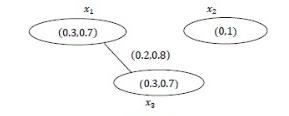
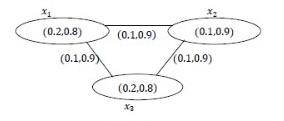
Definition 6. An G3 subgraph H H is said to be spanning G3 subgraph of H H if for all Definition 7. An agree-G3 graph H H over H is an G3 subgraph of H H defined as follows:
H H
Example 3. Consider Example 1, then, the agree-G3 graph H H over H .
Table 3. The agree- .
This table is shown in the PDF version of the article.
H H
Example 4. Consider Example 1, then the disagree-G3H H H over H .
Table 4. The disagree- .
This table is shown in the PDF version of the article.
H with where the membership and non membership of the union are as follows:
b g h b g h
b g h b g h
f b g hmapbl b g h p b g h
b g h p b g h
fbg p p b g hmapbl b g r h r b g r h b g r b g r h r r b g r h b g r b g r f r r
hmapbl b g r h p r b g r h b g r b g r h r p r b g r h b g r b g r fbg p r p r
hmapbl Proposition 1. The union H H of two G3Hl H H and H H is an G3H.
Proof: I. b g r , then r r fbg r
fbg r , so r fbg r .
Also r r fbg r fbg r
So r fbg r .
Now p r p r f p p r f p p r .
So p r f p p r .
Similarly if g r , or if g r
, we can show the same as done above.
II. b g r , then
r f r
f fbg r fbg r
fbg f f r r fbg r
Also
r fbg p r
fbg f p r f r
f fbg fbg r r Hence, the union H H H is an G3H.
Definition 10. The intersection of two G3Hl H H and H H is denoted by
H H with and the membership and non membership of the intersection
are as follows:
fbg b
fbg r r b
f r r b
Proposition 2. The intersection H H of two G3Hl H H and H H is an G3H where
Proof:
I. b , then r r fbg r fbg r ,
so r fbg r .
Now r r f r f r , so r f r . Similarly, b we can show the same as done above.
II. b , then
r f r
fbg fbg r fbg r
fbg fbg fbg r r fbg r
Now
r f r
f f r f r
f f f r r
Hence the intersection H H H is an G3H.
4. Applications of IFSEG
Assume that a company wants to fill a position to be chosen by an expert committee. Suppose that H be a simple graph with 9 be a set of parameters for computer knowledge. Let 8 i be a set of two expert committee members. An G3H is given in Table 5 below and and for all and for all After serious deliberation, the committee constructs the following G3H.
Table 5. .
This table is shown in the PDF version of the article.
The company may follow the following algorithm to fill the position:
I. Input the G3H.
II. Find the mean of each G3 edge according to the relationship among criteria for each alternative.
III. Find an agree-G3H and a disagree- G3H.
IV. Find D for agree- G3H.
V. Find for disagree- G3H.
VI. Find 3 D .
VII. Find for which l fl where,l is the optimal choice object. If r has more than one value, then the company could choose any one of them using its option.
G3 edges according to the relationship among criteria for each alternative.
Table 6. .
This table is shown in the PDF version of the article.
Table 7 presents the agree-G3H by using the mean of each G3H.
Table 7. Tabular presentation of the agree- .
This table is shown in the PDF version of the article.
Table 8 presents the disagree-G3H respectively, by using the mean of each G3H.
Table 8. Tabular presentation of the disagree-NSEG.
This table is shown in the PDF version of the article.
Table 9. Sum of agree- .
This table is shown in the PDF version of the article.
Table 10. Sum of disagree- .
This table is shown in the PDF version of the article.
Table 11. .
This table is shown in the PDF version of the article.
Since max 3 hence the committee will choose candidate with a master's degree for the job.
5. Conclusion
In this paper, we have introduced the concept of IFSEG, union and the intersection of them has been explained with an example which has broader application in the field of modern sciences and technology, especially in research areas of computer science, including database theory, data mining, neural networks, expert systems, cluster analysis, control theory, and image capturing.
Author Contribution
M. S. research design, conceptualization, and validation. V. U. data gathering, computing, and editing. The authors have read and agreed to the published version of the manuscript.
Funding
The authors declare that no external funding or support was received for the research.
Data Availability
All data supporting the reported findings in this research paper are provided within the manuscript.
Conflicts of Interest
The authors of this article are members of the UDA editorial board and did not participate in the editorial review or decision to publish this work. They have declared that they have no conflicts of interest related to this work.
References
- [1] Zadeh, L. A. (1965). Fuzzy sets. Information and control, 8(3), 338–353. https://doi.org/10.1016/S0019-9958(65)90241-X
- [2] Atanassov, K. T. (1986). Intuitionistic fuzzy sets. Fuzzy sets and systems, 20(1), 87–96. https://doi.org/10.1016/S0165-0114(86)80034-3
- [3] Molodtsov, D. (1999). Soft set theory-first results. Computers & mathematics with applications, 37(4–5), 19–31. https://doi.org/10.1016/S0898-1221(99)00056-5
- [4] Maji, P. K., Biswas, R., & Roy, A. R. (2003). Soft set theory. Computers & mathematics with applications, 45(4–5), 555–562. https://doi.org/10.1016/S0898-1221(03)00016-6
- [5] Alkhazaleh, S., & Salleh, A. R. (2011). Soft expert sets. Hindawi publishing corporation advances in decision sciences, 2011, 757861–757868. https://doi.org/10.48313/uda.v1i1.16
- [6] Nyambuya, G. G. (2014). A perdurable defence to Weyl’s Unified Theory. Journal of modern physics, 5(14), 1244–1253.
- [7] Mohinta, S., & Samanta, T. K. (2015). An introduction to fuzzy soft graph. Mathematica moravica, 19(2), 35–
- [48] http://elib.mi.sanu.ac.rs/files/journals/mm/28/Math.%20Moravican28p35-48.pdf
- [8] Muthuraj, R., & Sasireka, A. (2016). Fuzzy dominator coloring and fuzzy chromatic number on Cartesian product of simple fuzzy graph. Advances in theoretical and applied mathematics, 11(3), 245–260.
- [9] Mathew, S., & Sunitha, M. S. (2009). Types of arcs in a fuzzy graph. Information sciences, 179(11), 1760–1768. https://doi.org/10.1016/j.ins.2009.01.003
- [10] Mathew, S., & Sunitha, M. S. (2010). Node connectivity and arc connectivity of a fuzzy graph. Information sciences, 180(4), 519–531. https://doi.org/10.1016/j.ins.2009.10.006
- [11] Mathew, J. K., & Mathew, S. (2016). On strong extremal problems in fuzzy graphs. Journal of intelligent & fuzzy systems, 30(5), 2497–2503. https://doi.org/10.3233/IFS-151711
- [12] Rashmanlou, H., Samanta, S., Pal, M., & Borzooei, R. A. (2016). A study on vague graphs. SpringerPlus, 5(1), 1–12. https://doi.org/10.1186/s40064-016-2892-z
- [13] Shahzadi, S., & Akram, M. (2017). Intuitionistic fuzzy soft graphs with applications. Journal of applied mathematics and computing, 55, 369–392. https://doi.org/10.1007/s12190-016-1041-8
- [14] Ulucay, V., Sahin, M., & Olgun, N. (2018). Time-neutrosophic soft expert sets and its decision making problem. Infinite Study.
- [15] Uluçay, V., Kilic, A., Yildiz, I., & Șahin, M. (2018). A new approach for multi-attribute decision-making problems in bipolar neutrosophic sets. Neutrosophic sets and systems, 23, 142–159.
- [16] Uluçay, V., Sahin, M., & Hassan, N. (2018). Generalized neutrosophic soft expert set for multiple-criteria decision-making. Symmetry, 10(10), 437. https://doi.org/10.3390/sym10100437
- [17] Sahin, M., Olgun, N., Uluçay, V., Kargin, A., & Smarandache, F. (2017). A new similarity measure based on falsity value between single valued neutrosophic sets based on the centroid points of transformed single valued neutrosophic numbers with applications to pattern recognition. Infinite Study.
- [18] Sahin, M., Uluçay, V., & Acioglu, H. (2018). Some weighted arithmetic operators and geometric operators with SVNSs and their application to multi-criteria decision making problems. Infinite Study.
- [19] Dhar, M. (2021). Neutrosophic soft matrices and its application in medical diagnosis. Journal of fuzzy extension and applications, 2(1), 23–32. https://doi.org/10.22105/jfea.2021.246237.1000
- [20] Sahin, M., Alkhazaleh, S., & Ulucay, V. (2015). Neutrosophic soft expert sets. Applied mathematics, 6(1), 116. https://fs.unm.edu/NeutrosophicSoftExpert.pdf
- [21] Ulucay, V., Deli, I., & Sahin, M. (2018). Similarity measures of bipolar neutrosophic sets and their application to multiple criteria decision making. Neural computing and applications, 29, 739–748. https://doi.org/10.1007/s00521-016-2479-1
- [22] Sahin, M., Deli, I., & Uluçay, V. (2016). Jaccard vector similarity measure of bipolar neutrosophic set based on multi-criteria decision making. Infinite Study.
- [23] Hassan, N., Uluçay, V., & Sahin, M. (2018). Q-neutrosophic soft expert set and its application in decision making. International journal of fuzzy system applications (IJFSA), 7(4), 37–61.
- [24] Broumi, S., Bakali, A., Talea, M., Smarandache, F., Singh, P. K., Uluçay, V., & Khan, M. (2019). Bipolar complex neutrosophic sets and its application in decision making problem. Fuzzy multi-criteria decision-making using neutrosophic sets, 677–710. https://doi.org/10.1007/978-3-030-00045-5_26
- [25] Ulucay, V., Kılıç, A., Sahin, M., & Deniz, H. (2019). A new hybrid distance-based similarity measure for refined neutrosophic sets and its application in medical diagnosis. Infinite Study.
- [26] Lakdashti, A., Rashmanlou, H., Borzooei, R. A., Samanta, S., & Pal, M. (2019). New concepts of bipolar fuzzy graphs. Journal of multiple-valued logic & soft computing, 33(1), 135-154. https://www.researchgate.net/publication/330278665_New_Concepts_of_Bipolar_Fuzzy_Graphs
- [27] Saberhoseini, S. F., Edalatpanah, S. A., & Sorourkhah, A. (2022). Choosing the best private-sector partner according to the risk factors in neutrosophic environment. Big data and computing visions, 2(2), 61–68. https://doi.org/10.22105/bdcv.2022.334005.1075
- [28] Akram, M., Akram, M., & Cecco, D. (2019). M-polar fuzzy graphs. Springer.
- [29] Das, S. K., & Dash, J. K. (2020). Modified solution for neutrosophic linear programming problems with mixed constraints. Infinite Study.
- [30] Mandal, S., & Pal, M. (2019). Product of bipolar intuitionistic fuzzy graphs and their degree. TWMS journal of applied and engineering mathematics, 9(2), 327–338. https://dergipark.org.tr/en/pub/twmsjaem/article/761039
- [31] Kalathian, S., Ramalingam, S., Srinivasan, N., Raman, S., & Broumi, S. (2020). Embedding of fuzzy graphs on topological surfaces. Neural computing and applications, 32, 5059–5069. https://doi.org/10.1007/s00521-018-3948-5
- [32] Rashmanlou, H., Pal, M., Raut, S., Mofidnakhaei, F., & Sarkar, B. (2019). Novel concepts in intuitionistic fuzzy graphs with application. Journal of intelligent & fuzzy systems, 37(3), 3743–3749. https://doi.org/10.3233/JIFS-182961
- [33] Gani, A. N., & Ahamed, M. B. (2003). Order and size in fuzzy graphs. Bulletin of pure and applied sciences, 22(1), 145–148.
- [34] Gani, A. N., & Begum, S. S. (2010). Degree, order and size in intuitionistic fuzzy graphs. International journal of algorithms, computing and mathematics, 3(3), 11–16.