
An Uncertainty Aware Fuzzy Fractional Model for Thermo Viscoelastic Vibration of a Size Dependent
Abstract
This study develops a fractional phase framework for transient thermo viscoelastic vibrations of size-dependent uniaxial microbeams. Inherited damping, uncertain thermal loading, and micro scale stiffness effects are incorporated into a unified reduced-order model. The first mode reduction yields a fractional Kelvin Voight oscillator with temperature and size dependent effective stiffness. The fractional damping term is discretized using the L1 scheme, while the inertial dynamics is solved by central finite differences. Numerical results show that fractional order, thermal uncertainty, and size effects significantly affect the displacement and resonance behavior. The proposed model provides a transparent computational framework for coupling fractional dynamics, phase uncertainty, and vibration analysis at the micro/nano scale.
Keywords:Fractional viscoelasticityThermo mechanical vibrationSize dependent microbeamFuzzy uncertaintyCaputo derivative
1. Introduction
Micro and nano scale mechanical structures increasingly operate under coupled mechanical, thermal, and environmental conditions. Polymer based components, smart composites, Microelectromechanical Systems (MEMS), Nanoelectromechanical Systems (NEMS), resonators, and compliant sensors may exhibit both history dependent dissipation and size-dependent stiffness. Classical integer order viscoelastic models can represent exponential relaxation mechanisms, but they may require several characteristic times to reproduce broad power law like memory effects. Fractional constitutive models provide a compact alternative because the fractional order directly controls the temporal memory of the material response [1–9]. A second challenge arises from the fact that thermal conditions in practical microstructures are rarely known exactly. Temperature dependent material properties, interface effects, environmental fluctuations, and operating uncertainty may prevent the construction of a reliable probabilistic distribution. In such situations, fuzzy set descriptions provide a useful alternative because uncertain physical quantities can be represented by admissible intervals at prescribed confidence levels [10–14]. Microbeam dynamics also differ from their macroscopic counterparts because surface effects, strain gradients, couple stresses, and nonlocal interactions may modify the effective bending stiffness. A number of size dependent Euler Bernoulli and generalized continuum models have consequently been developed for micro and nano scale structures [15–19]. The literature therefore contains three mature modeling directions: fractional viscoelasticity for temporal memory [1–9], [20], fuzzy representations for uncertain differential equations [10–14], and size dependent continuum models for microstructures [15–19]. The present study does not claim that these ingredients are individually new. Instead, the objective is to construct a mathematically explicit reduced order framework in which the three effects can be varied independently and then examined jointly in a single transient vibration problem. The main contributions of this study are therefore as follows. First, a normalized first mode thermo viscoelastic oscillator is formulated with a Caputo fractional damping operator. Second, uncertain thermal loading is represented by a triangular fuzzy parameter and evaluated through representative α − cut scenarios. Third, size dependence is introduced through a scalar stiffness factor so that temporal memory, thermal uncertainty, and structural scale can be separated during sensitivity analysis. Finally, a reproducible L1 based numerical procedure is developed for direct MATLAB implementation. The proposed model is deliberately reduced order. It is not intended to replace a distributed finite element or fully coupled thermo mechanical formulation. Its purpose is to provide an interpretable screening model for preliminary vibration analysis, parameter sensitivity studies, and uncertainty aware design of small mechanical structures.
2. Physical Model
2.1 Euler Bernoulli Beam and First Mode Reduction
Consider a slender cantilever microbeam of length L, cross sectional area A, second moment of area I, mass density ρ, and transverse displacement w(x, t). For small transverse deflections and negligible shear deformation, the Euler Bernoulli kinematic assumption is adopted. The displacement field is approximated by the first cantilever mode:
w(x, t) ≈ φ1 (x)q(t), (1)
where q(t) is the generalized modal coordinate and φ1 (x) is the normalized first mode shape. For a classical cantilever beam, the first characteristic root satisfies β1L ≈ 1.875104.
The corresponding classical first natural frequency is
EI
2 (2)
ω1 = β1√ .
ρAL
For the present normalized benchmark, the reference modal frequency is selected as ω0 = 18. The normalized value ω0 = 18 allows the effects of fractional memory, thermal uncertainty, and size dependence to be investigated independently of a particular material system.
2.2 Fractional Kelvin Voigt Modal Model
The hereditary damping mechanism is represented by a fractional Kelvin Voigt contribution. After first mode projection and normalization of the modal mass, the governing equation becomes γ 1 q (τ)
D q(t) = ∫ dτ. (3)
Γ(1 − γ) (t − τ)
In the limiting case γ = 1
D q(t) = q′(t), (4)
and therefore Eq. (4) reduces to the classical viscous damping model [1–9]
q′′(t) + ω (t)q(t) + cfq′(t) = F(t). (5)
The fractional order γ controls the memory depth of the damping mechanism. Smaller values of γ produce a more pronounced hereditary contribution and modify both the phase and decay characteristics of the transient response.
2.3 Thermal Softening
Thermal loading is introduced through a time-dependent effective modal stiffness:
2 2 2
ω (t) = ω0 S [1 − χ Θ(t)], (6)
where S is a dimensionless size stiffness factor, χ is the normalized thermal sensitivity coefficient, and Θ(t) is the prescribed dimensionless temperature rise. The thermal history is modeled as
Θ(t) = θs [1 − exp (− )]. (7)
The thermal time constant and normalized thermal sensitivity are selected as
T = 3s, χ = 0.10. (8)
The parameter θs controls the amplitude of the thermal excursion. The benchmark considers
θs ∈ {0.7, 1.0, 1.3}. (9)
Eq. (7) should be interpreted as a reduced thermoelastic softening law rather than as a fully coupled heat transfer model. In a future Multiphysics formulation, the temperature field Θ(x, t) may be obtained from an appropriate heat transfer equation and subsequently incorporated into the distributed beam stiffness.
A temperature rise can reduce the effective bending stiffness through a thermoelastic correction. In the reduced model this is written as where ω0 = 18 in the normalized benchmark, S is a size-stiffness factor, χ = 0.10 is the selected thermal sensitivity, and Θ(t) is a dimensionless temperature rise. The imposed thermal history is the scalar θs is treated as fuzzy through three uncertainty scenarios: 0.7, 1.0, and 1.3. This is a compact α cut style representation, not a calibrated material temperature law. The formulation can be replaced directly by a measured temperature field in a future experimental study.
2.4 Size Dependent Stiffness
To isolate the influence of scale effects, the effective modal frequency is multiplied by the normalized factor S. Thus
ω (t) = ω S √1 − χ Θ(t). (10)
eff 0
Values satisfying, S > 1.
Classical modal reduction produces a second order oscillator. To represent hereditary damping, the viscous term is replaced by a fractional Kelvin Voigt contribution:
The fractional order γ controls the breadth of the memory kernel. For γ = 1 the damping term becomes classical viscous damping. For 0 < γ < 1 it introduces a long tailed hereditary contribution consistent with fractional viscoelasticity [1–9]. The coefficient cf is a normalized damping parameter and F(t) is the generalized forcing.
At micro scale, the bending rigidity may deviate from the classical EI prediction. A simple screening representation is to use a normalized factor S multiplying the nominal modal frequency. Values S > 1 represent size induced stiffening in the chosen convention. More rigorous models can substitute couple stress or strain-gradient expressions with an internal length scale [15–19]. The aim here is to preserve a scalar parameter so the effect can be isolated from fractional memory and thermal uncertainty.
3. Fuzzy Fractional Formulation
3.1 Fuzzy State Description
Let q ̃(t) denote a fuzzy generalized displacement. At each confidence level r, the displacement interval is [qL(t, r), qU(t, r)]. The two endpoint problems use identical mechanics but different uncertain coefficients. This extension follows the level set viewpoint of fuzzy differential equations [10–14] and is preferable to replacing a physical parameter by a single arbitrary expected value.
[q ̃(t)]r = [qL(t, r), qU(t, r)], 0 ≤ r ≤ 1. (11)
In the numerical experiments the three plotted scenarios are interpreted as lower, core, and upper uncertainty paths. When field data are available, the same software structure can be populated with experimentally identified α −cuts.
3.2 Fractional Constitutive Interpretation
Fractional viscoelasticity is attractive for materials whose creep and relaxation functions exhibit non-exponential, power law like behavior. Bagley and Torvik [1] established a theoretical foundation for the fractional representation, while Mainardi [3] and subsequent authors developed systematic links to hereditary kernels and mechanical wave propagation. Fractional beam formulations have since been demonstrated for Euler Bernoulli beams, cantilever beams, moving load problems, and experimentally informed microbeam models [4–9]. The present model borrows that constitutive logic but keeps the structural dynamics in a one-coordinate form so the uncertainty and parameter effects remain interpretable.
4. Numerical Scheme
4.1 L1 Approximation for the Damping Memory
On tn = nh, the Caputo derivative is approximated by
D q(t) ≈ ∑ an,j(qj+1 − qj), (12)
Γ(2 − γ)h
1−γ 1−γ
an,j = (n − j) − (n − j − 1) . (13)
The acceleration is discretized by the centered second difference. Because the last L1 history increment contains qn, the scheme can be rearranged into an explicit algebraic formula for the new displacement coordinate:
qn − 2qn−1 + qn−2
q̈(t ) ≈ . (14) Since the latest L1 date increment contains the unknown qn, the resulting scheme can be rearranged into the following explicit algebraic formula for the new displacement coordinates.
2qn−1 qn−2 Fn + 2 − − 2 − cfA(Hn − qn−1)
h h (15)
qn = .
+ ω (tn) + cfA
A = . (16)
Γ(2 − γ)h
This form is computationally convenient because the numerical kernel is transparent and the effects of h and γ can be isolated. Direct history storage is O(N) in memory and O(N²) in arithmetic cost.
4.2 Excitation
The normalized forcing combines a decaying harmonic excitation with a short startup pulse
−0.08t −2(t−0.5 (17)
F(t) = 0.08 sin(17.5t)e + 0.05 H(t − 0.5)e }.
The forcing frequency is intentionally close to the nominal modal frequency 18, creating a mild resonance like regime in which damping-memory effects can be observed without requiring a fully nonlinear beam model.
5. Numerical Experiments
5.1 Fractional-Order Effect
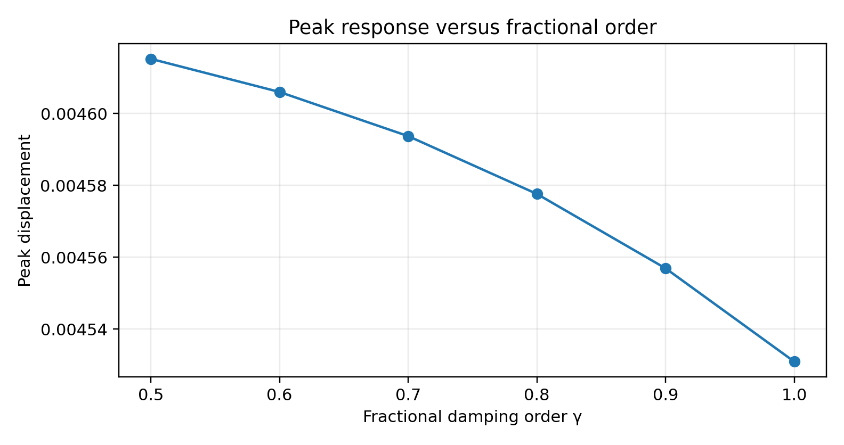
The response curves show a systematic but moderate change in the vibration tail as γ decreases. In the normalized test, the peak displacement changes from approximately 0.004531 at γ = 1 to 0.004616 at γ = 0.5, while the RMS response increases accordingly. This magnitude should not be universalized; it is a property of the selected dimensionless benchmark. The more important result is qualitative: The fractional order changes both phase and memory of the damping process, so fitting a single classical damping ratio may mask a meaningful time-history effect.
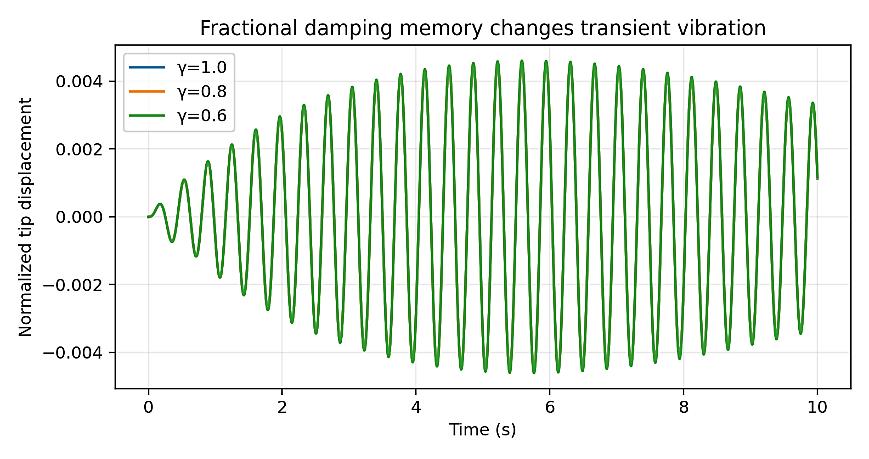
Table 1. Effect of fractional damping order on vibration response.
This table is shown in the PDF version of the article.
5.2 Thermal Uncertainty
The upper thermal scenario produces the largest response because thermal softening lowers the instantaneous effective stiffness. This result is mechanically intuitive and also demonstrates why separating uncertainty from memory is useful. The fractional order γ can be held fixed while the thermal envelope changes, or the thermal state can be identified more accurately while γ remains uncertain. The two effects need not be confounded in the model.
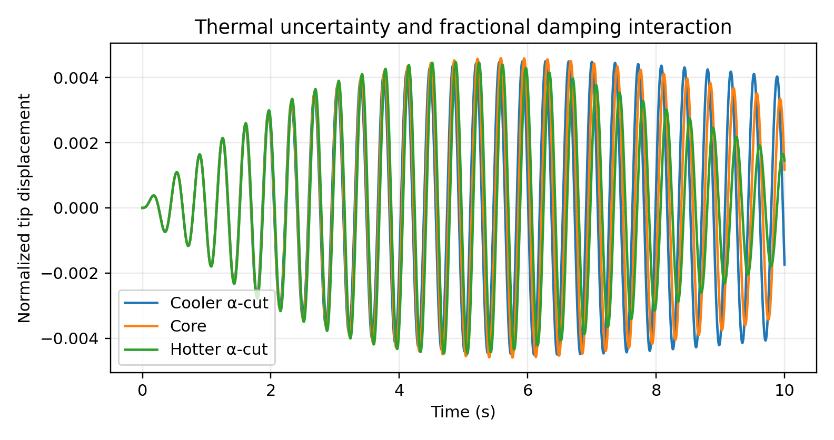
Table 2. Sensitivity to thermal uncertainty.
This table is shown in the PDF version of the article.
5.3 Sensitivity to Fractional Order
Fig. 3 shows the nonlinearity of the parameter to response map, even though the governing equation is linear in q. This is a consequence of the nonlocal fractional history term. For design studies, it means that a small uncertainty in γ can matter more near resonance than in a low frequency off resonance regime. Consequently, calibration of fractional order should be performed on the same class of operating conditions used for prediction.
5.4 Size Effect
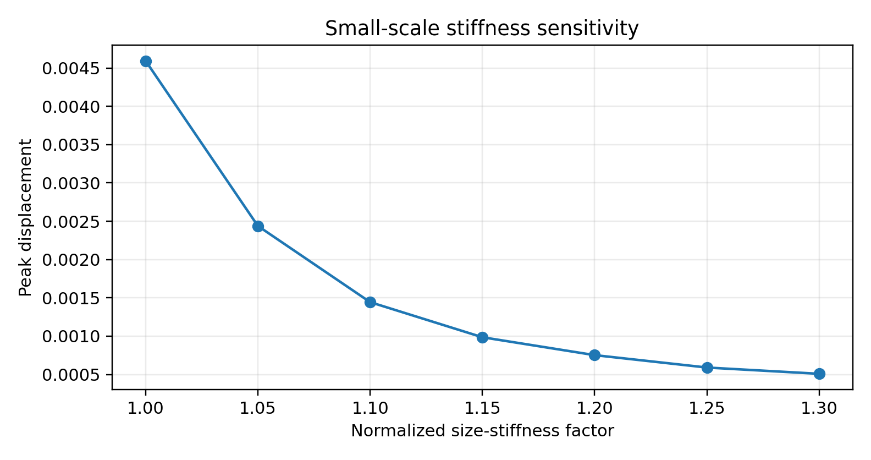
Increasing the normalized size stiffness factor shifts the effective modal frequency away from the forcing frequency and reduces the peak displacement over the selected benchmark range S ≥ 1.0. The figure should therefore be read as a sensitivity study, not as a universal constitutive law. In a full microbeam model, S would be replaced by an explicit internal length scale relation obtained from strain gradient or couple stress mechanics [15–19].
5.5 Numerical Consistency Check
A practical check for a fractional mechanical solver is to repeat the computation with smaller h and monitor the change in a scalar response metric such as peak displacement. Because the benchmark is not an exact manufactured solution, the present study uses self-convergence against a fine grid reference rather than claiming an analytical order of convergence. For publication quality validation, an additional manufactured fractional oscillator or a published benchmark with a known solution should be included.
Table 3. Self-convergence check for the fractional time integrator.
This table is shown in the PDF version of the article.
6. Interdisciplinary Engineering Interpretation
6.1 Dynamics and Vibration Engineering
From a dynamic's perspective, the reduced model is a hereditary single degree of freedom representation of the first beam mode. This makes it suitable for rapid parametric sweeps, controller co design, and preliminary safety screening. Full finite element models remain necessary when higher modes, boundary nonlinearities, distributed heating, cracks, or strong geometric nonlinearities are important [21–25].
6.2 Micro/Nano Mechanics
The size factor S is a placeholder for a richer microstructural theory. Experimental and computational studies of microbeams show that surface effects, strain gradients, couple stress, and nonlocal interactions can materially change natural frequencies and static stiffness [15–19]. The fractional memory term is complementary to those spatial effects: it modifies temporal constitutive response, whereas the size factor modifies spatial stiffness. Treating them as separate modules makes the model easier to calibrate.
6.3 Thermal and Energy Interpretation
The thermal uncertainty layer also makes the model relevant to energy and environment applications. Micro-and nano devices can operate in conditions where temperature changes affect stiffness, damping, and resonance. A fuzzy temperature envelope can therefore serve as an early-stage design variable in MEMS/NEMS, sensors, resonators, and smart structures. The 2026 literature has already begun to combine fractional heat conduction ideas with Timoshenko microbeam vibration [20], making the proposed framework a natural bridge to Multiphysics extensions.
6.4 Design Implications
Three practical design observations emerge. First, estimating only a classical damping ratio can miss memory effects in long transients. Second, thermal uncertainty can shift resonance conditions enough to dominate the relatively subtle influence of the fractional order. Third, size-dependent stiffness can be used as a design variable rather than treated solely as a modeling nuisance. The fuzzy fractional formulation places all three effects on a common computational platform.
7. Limitations and Future Work
The beam model uses first mode reduction and normalized coefficients; it is not a replacement for a full distributed Multiphysics model.
Thermal softening is represented by a scalar coefficient. Thermoelastic coupling, nonlinear temperature fields, and conduction regimes are omitted.
The size effect is represented by a screening factor S rather than a fully derived strain gradient/couple-stress constitutive law.
No experimental validation is claimed. The next stage should calibrate γ and the temperature uncertainty band from measured vibration data.
A fuzzy fractional finite element formulation could extend the method to composite beams, plates, rotating shafts, or smart structures.
8. Conclusion
A unified fractional phase framework is developed for the analysis of transient vibration of thermally and size-dependent microbeams under uncertain operating conditions. This formulation integrates three effects that are often considered independently: inherited viscoelastic damping via a fractional Kelvin Voight operator, uncertain thermal loading via uncertain temperature envelopes, and microscale stiffness modification via a normalized size-dependent parameter. This combination provides a reduced order model in which time memory, thermal uncertainty, and size effects can be considered in a common mathematical framework. Numerical results show that these mechanisms affect the vibration response in distinct but interacting ways. Changes in fractional order primarily affect the memory induced decay and transient response sequence, while thermal uncertainty changes the effective stiffness and response amplitude. The size-dependent stiffness coefficient changes the effective modal frequency and thus the resonance margin of the microbeam. These results highlight the importance of considering fractional memory and uncertain thermal effects when analyzing resonant structures at the microscale. From a methodological point of view, the proposed formulation provides a transparent computational framework for separating and subsequently combining spatial scale effects, temporal memory, and imprecise thermal information. The resulting model is particularly suitable for sensitivity analysis, preliminary design studies, and numerical prototyping of micro-and nanomechanical systems. All numerical findings reported in this study follow directly from the mathematical model and discretization method presented here and should therefore be interpreted as model-based computational results, not experimental observations. This framework also establishes a direct connection between fuzzy fractional differential equations and engineering problems involving microscale dynamics, thermal effects, vibration, and smart structures. Future developments should include physically derived size-dependent structural relations, experimentally calibrated material parameters, contributions of higher states, and experimental validation. Such developments will provide a stronger basis for evaluating the predictive ability of the proposed fuzzy fractional formulation in practical micro- and nanomechanical applications.
References
- [1] Bagley, R. L., & Torvik, P. J. (1983). A theoretical basis for the application of fractional calculus to viscoelasticity. Journal of rheology, 27(3), 201–210. https://doi.org/10.1122/1.549724
- [2] Shimizu, N., & Zhang, W. (1999). Fractional calculus approach to dynamic problems of viscoelastic materials. JSME international journal series c mechanical systems, machine elements and manufacturing, 42(4), 825–837. https://doi.org/10.1299/jsmec.42.825
- [3] Mainardi, F. (2022). Fractional calculus and waves in linear viscoelasticity. World Scientific Publishing Company. https://doi.org/10.1142/p614
- [4] Di Paola, M., Heuer, R., & Pirrotta, A. (2013). Fractional visco-elastic Euler–Bernoulli beam. International journal of solids and structures, 50(22), 3505–3510. https://doi.org/10.1016/j.ijsolstr.2013.06.010
- [5] Freundlich, J. (2019). Transient vibrations of a fractional Kelvin-Voigt viscoelastic cantilever beam with a tip mass and subjected to a base excitation. Journal of sound and vibration, 438, 99–115. https://doi.org/10.1016/j.jsv.2018.09.006
- [6] Praharaj, R. K., & Datta, N. (2020). Dynamic response of Euler-Bernoulli beam resting on fractionally damped viscoelastic foundation subjected to a moving point load. Proceedings of the institution of mechanical engineers, part c: journal of mechanical engineering science, 234(24), 4801–4812. https://doi.org/10.1177/0954406220932597
- [7] Shitikova, M. V. (2022). Fractional operator viscoelastic models in dynamic problems of mechanics of solids: A review. Mechanics of solids, 57(1), 1–33. https://doi.org/10.3103/S0025654422010022
- [8] Bonfanti, A., Kaplan, J. L., Charras, G., & Kabla, A. (2020). Fractional viscoelastic models for power-law materials. Soft matter, 16(26), 6002–6020. https://doi.org/10.1039/d0sm00354a
- [9] Łabędzki, P. (2025). Fractional Kelvin–Voigt model for beam vibrations: Numerical simulations and approximation using a classical model. Electronics, 14(10), 1–18. https://doi.org/10.3390/electronics14101918
- [10] Zadeh, L. A. (1965). Fuzzy sets. Information and control, 8(3), 338–353. https://doi.org/10.1016/S0019-9958(65)90241-X
- [11] Kaleva, O. (1987). Fuzzy differential equations. Fuzzy sets and systems, 24(3), 301–317. https://doi.org/10.1016/0165-0114(87)90029-7
- [12] Kaleva, O. (1985). On the convergence of fuzzy sets. Fuzzy sets and systems, 17(1), 53–65. https://doi.org/10.1016/0165-0114(85)90006-5
- [13] Buckley, J. J., & Feuring, T. (2000). Fuzzy differential equations. Fuzzy sets and systems, 110(1), 43–54. https://doi.org/10.1016/S0165-0114(98)00141-9
- [14] Allahviranloo, T., Ahmady, N., & Ahmady, E. (2007). Numerical solution of fuzzy differential equations by predictor–corrector method. Information sciences, 177(7), 1633–1647. https://doi.org/10.1016/j.ins.2006.09.015
- [15] Fu, G., Zhou, S., & Qi, L. (2019). A size-dependent Bernoulli-Euler beam model based on strain gradient elasticity theory incorporating surface effects. ZAMM - journal of applied mathematics and mechanics / zeitschrift für angewandte mathematik und mechanik, 99(6), e201800048. https://doi.org/10.1002/zamm.201800048
- [16] Yin, S., Xiao, Z., Deng, Y., Zhang, G., Liu, J., & Gu, S. (2021). Isogeometric analysis of size-dependent Bernoulli–Euler beam based on a reformulated strain gradient elasticity theory. Computers & structures, 253, 106577. https://doi.org/10.1016/j.compstruc.2021.106577
- [17] Park, S. K., & Gao, X. L. (2006). Bernoulli–Euler beam model based on a modified couple stress theory. Journal of micromechanics and microengineering, 16(11), 2355. https://doi.org/10.1088/0960-1317/16/11/015
- [18] Yang, F., Chong, A. C. M., Lam, D. C. C., & Tong, P. (2002). Couple stress based strain gradient theory for elasticity. International journal of solids and structures, 39(10), 2731–2743. https://doi.org/10.1016/S0020-7683(02)00152-X
- [19] Eringen AC, A., & Wegner JL, R. (2003). Nonlocal Continuum Field Theories. Springer. https://doi.org/10.1007/b97697
- [20] Awad, E., & El-Dhaba, A. R. (2026). The role of fractional calculus in modeling vibrations of a Timoshenko beam influenced by low and high thermal conduction. European journal of mechanics - a/solids, 118, 106100. https://doi.org/10.1016/j.euromechsol.2026.106100
- [21] W. Weaver, J., Timoshenko, S. P., & Young, D. H. (1991). Vibration problems in engineering. Wiley. https://www.wiley.com/en-us/shop/general-introductory-mechanical-engineering/vibration-problems-in-engineering-5th-edition-p-9780471632283
- [22] Meirovitch, L. (1975). Elements of vibration analysis. McGraw-Hill. https://books.google.com/books/about/Elements_of_Vibration_Analysis.html?id=PVm6QgAACAAJ
- [23] Nayfeh, A. H., & Mook, D. T. (2024). Nonlinear oscillations. John Wiley & Sons. https://www.wiley.com/en-us/shop/general-physics/nonlinear-oscillations-p-9783527617593
- [24] Warburton, G. B. (1993). Dynamics of structures11394‐7. McGraw-Hill. https://books.google.com/books/about/Dynamics_of_Structures.html?id=HxLakQEACAAJ
- [25] Caputo, M., Fabrizio, M., & others. (2015). A new definition of fractional derivative without singular kernel. Progress in fractional differentiation and applications, 1(2), 73–85. http://dx.doi.org/10.12785/pfda/010201